A Serial Music Journey from Indonesian Volcanoes to Zurich’s Snowy Scenery
proton d-oo-b (Switzerland)
Traveling with the Muro Box: A Creative Journey from Indonesian Volcanoes and Zurich’s Snowy Scenery to Serial Music
proton d-oo-b (瑞士)
Hi everyone, I’m proton d-oo-b from Switzerland. Alchemelic is a unique music project I started in 2016.
Alchemelic is composing music for a music box that imagines a Renaissance rave. The piece blends elegant, repetitive melodies with vibrant energy.
Searching for “New Music”: The Birth of Serial Composition
A selection of Alchemelic album covers, showcasing a distinctive style where visual art and music converge.
Many of my musician friends told me that it’s impossible these days to create new music that isn’t just experimental noise. They believed that any music following traditional harmony rules and patterns would inevitably sound like another band or composer. I couldn’t accept this idea and became obsessed with finding a way to compose music that had never been heard before, yet didn’t remind people of any existing compositions.
I had a lot of experience with randomly generated 3D art in virtual worlds, where I started experimenting with randomized art creation back in 2007. Inspired by this, I wanted to try something similar with music instead of visual experiences.
You can see some examples of my work with randomized art here:
https://youtu.be/z_FoCdslpsc
and
https://www.kunstnet.org/werk/92903-444-prims-performance-prt2
Discover Alchemelic’s music box arrangements on the Muro Box online music library.
My process is a blend of emotional intuition and random chance. I use my heart to choose the right melodies, but the initial inspiration comes from a random source, like throwing dice. I accept the flaws that come with this random generation. Essentially, I program random melody generators that present me with an endless stream of new compositions, and I then select the ones that resonate with me the most.
This method is highly influenced by the work of https://www.wikiart.org/en/marcel-duchamp
Note: Serialism is a modern music composition technique that emerged in the 20th century. Its characteristic feature is the organization of musical elements—such as pitch, duration, and dynamics—according to predetermined mathematical sequences, which are then repeated throughout the piece. This method was pioneered by Arnold Schoenberg’s twelve-tone technique and later developed into total serialism, which applies serial principles to a broader range of musical elements.
Discovering the Muro Box for Street Performances
I aimed to take my music to the streets and wanted to explore the potential for real-life performance. My initial plan was to play music using loudspeakers, but I soon discovered that this was not allowed. To overcome this challenge, I considered using a music box with punch cards. While searching for a suitable music box, I came across the Muro Box on Amazon and believed it was the ideal solution for showcasing my work on the streets of Zurich.
For me, Muro Box plays a significant role in my music creation because it turns my compositions into something simplified and different. The result is music that I find to be calming and inspiring to all living creatures.
First Unforgettable Moment Playing Your Own Composition on the N20
proton d-oo-b recorded footage from the live-streaming Muro Box and invites everyone to try it out—experience the remotely controlled Muro Box, available 24/7 from anywhere in the world.
https://murobox.com/en/#TWITCH
The first time I used the N20 to play my own compositions was on the Muro Box website. I uploaded my MIDI file and was able to listen to the music box playing it on a live video stream. It felt like a miracle to see this machine, so far away on the other side of the planet, playing my beloved melody, “Snowglobe.” I had composed the piece at dawn, right after I learned that my mother had passed away.
Traveling with the Muro Box
I try to mix the beauty of nature with music box melodies. I specifically chose Renaissance music for a few reasons. It represents the culture I was raised in, and I think it’s important to show how that culture originally strived to create a world very different from what we have today.
The music theory itself was developed in an ecologically intact environment, though people at the time could never have anticipated the degrees of pollution and landscape reshaping we have now.
Back then, nature was primarily viewed as a dangerous place, with the only tamed areas being small gardens and parks. It pains me to see the state of our environment today, and through my work, I express a deep desire for a clean environment, peaceful landscapes, and a world free of pollution and war.
Unexpected Moments and Surprises While Filming on the Volcano
For my project in Indonesia, I chose to use an N20 Lite instead, as it is easier to power, transport, and is significantly lighter and less expensive.
While recording my song “Alchemelic – Ahoy (Kawah Putih)” at the Kawah Putih volcano, a memorable and unexpected event occurred. Park rangers began to remove the flags that had been put up for Indonesia’s Independence Day, which was on August 17, 2025. It happened right as I was filming, and I had a surreal moment where it felt as if they were doing it at my request. Throughout the experience, the people passing by clearly enjoyed what they heard and stopped to listen to the music.
Behind-the-scenes footage of proton d-oo-b filming at Kawah Putih Volcano.
From Owning the N20 to Collecting the N40
The sound of the N40 is truly amazing and delightful, and I am very satisfied with both its audio quality and its appearance. The only challenge I have is figuring out how to handle the maintenance.
My main problem is that I cannot change the comb of the music box myself. If even one note sounds numb, the whole experience is ruined. The only way to fix this is to send the N40 to Taiwan for repair, which is not cheap. Because of this, I have decided to use the N40 only when it’s part of a project or a fun idea, and otherwise, I just listen to its magic on video. For my project in Indonesia, I chose to use an N20 Lite instead, as it is easier to power, transport, and is significantly lighter and less expensive.
My motivation for wanting to meet the Muro Box team in Taiwan was to learn how to replace the comb and perform maintenance myself. I saw on your webshop that you offer a course to assemble and disassemble the N20, and I hoped to acquire all the skills needed to fix my music box. This would allow me to finally use it without constant worry, knowing that in the event of any damage, I could order replacement parts and fix it myself.
On a more personal note, after such a long and inspiring collaboration, I also wanted to meet the amazing Hung-Yin Liu and of course the Murobox Team in person.
(Regarding proton d-oo-b’s concerns about potential damage, we have responded to him and would like to clarify here: we offer repair services within three years with no labor or parts wear fees—you only need to cover the shipping costs. Therefore, please feel free to use your N40 with confidence, whether to fully explore its creative potential or simply let it play music for you, bringing wonderful atmosphere and memories to each day.)
The N40 music box is so precious to me that I only dare to use it for special projects, like the time it snowed for one day during Christmas in my city of Zurich. You can see a video of this project here:
N20 and N40: My Personal Experience
If you compare the different versions of the songs you worked on, you can hear that the N40 version consistently represents the original mood more effectively. The N20 version is still very close and interesting to listen to, but I personally feel more immersed in the N40 version. This is true for almost all 30 songs we’ve worked with.
Below are the links to the different versions of my piece “Swamp”:
The N40 Piece I Most Want the World to Hear
I would choose the piece “Birds” because of its deeply evocative and grounding qualities. The melody has a wonderful, solid foundation, like a serene landscape waiting for a storm. From that stillness, the melody begins to gently fall, calmly dripping in like the very first raindrops of a coming rain—each note a soft, deliberate moment.
As the performance continues, the melody evolves, unfolding into new dimensions and leaving a vast, open space for fantasy and imagination to take flight within the mind of the listener.
The Deep Emotional Value Brought by Muro Box
The most compelling value of the music box goes beyond its functions; it’s the emotional connection it creates. The sound is a unique and calming experience, a significant departure from the sound from a standard speaker.
While a speaker broadcasts a pre-recorded sound, the music box feels like a living instrument, a soft, resonant presence that is being played just for you. Listening to it brings a profound sense of peace, nourishing the heart and soul in a way that is truly special.
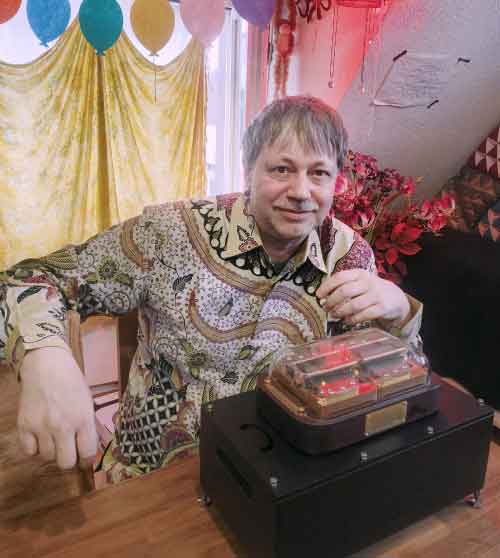
proton d-oo-b repeatedly customized Muro Box music boxes, loading his own compositions to give as special gifts to friends and family.
My friends and family absolutely love listening to my music on the Muro Box. They see it as a very precious gift that will help them keep the memories of me and my work close to their hearts forever.
Integrating Literature: The Core Spirit of Robotic Resonance
The idea to connect with Chinese poetry came from my research into AI voiceovers. I discovered a workflow that allowed me to create an artificial Chinese voiceover, and I was fascinated by this new ability to combine the unique sound of the music box with a spoken Chinese poem. I then asked the music arranger, Hung-Yin Liu, to help me choose a beautiful poem.
As for the future, I would be interested in exploring any classical works or poems that would lend themselves well to this combination of music and spoken word.
I am also fascinated by the historical context of Renaissance music. It was mainly developed by musicians who worked for European kings and were under immense pressure to please them, as their livelihood depended on their patron’s favor. Losing that favor could mean a loss of employment, a decline in status, or financial ruin, which was a devastating outcome for a composer. There was also a competition among kings to be the most sophisticated. Unlike those composers, my music is not affected by such dangerous circumstances. I use their knowledge in a modern way, incorporating repetition and redundancy, just as modern music does. This approach has allowed me to create something truly new and unique.
The term “robotic resonance” can be understood in multiple ways. On one level, it can be the title for a piece of music or art, evoking electronic sounds, mechanical processes, or an abstract concept of how robots metaphorically “resonate” with their environment or with humans.
In the context of AI and robotics, it can also refer to positive feedback loops within a robot’s learning algorithm. Repeated successful interactions or data patterns can reinforce certain neural pathways or decision-making heuristics, making them more likely to be activated in the future. This resonance helps solidify learned behaviors.
For me, the most important meaning is that my music can resonate with its surroundings. I want to see how people or animals react to it, and how the melodies can create a connection with the world around them.
A Tribute to the Community’s Top 14 Favorites
I am proud to announce the upcoming release of ‘Alchemelic – Alchemy.’
Arriving this month, this collection features the 14 most-listened-to tracks from the Muro Box app. This album celebrates the community’s favorites, presenting them both in their original forms and as reimagined remixes, built upon the precision MIDI arrangements of the amazingly talented Hung-Yin Liu.
Here is my Spotify artist profile:
You can listen to my music there and preview my upcoming album.
My work is also available on all major streaming platforms—just search for “Alchemelic.”