From Memory to Modern Day: A Forty-Year Journey with Music Boxes

Kyooh’s manual inspection of early-design 3S movements. Due to stop lever deformation, around 300,000 units were recalled for rechecking.

From Memory to Modern Day: A Forty-Year Journey with Music Boxes

(Author: Muro Box Founder Chen-Hsiang Feng, based on a 2025/02/27 interview with Kyooh General Manager Huang Long-Xi)

Thank you all for the enthusiastic response to our report on the “The Birth Place of Music Box” To give you a deeper understanding of the story of music boxes in Taiwan, we revisited Kyooh and spoke with General Manager Huang Long-Xi.

Kyooh is Taiwan’s only music box factory, with over 40 years of history—from OEM work to innovation, and the establishment of a modern music box museum. It stands as a witness to Taiwan’s industrial transformation. Join us as we revisit Taiwan’s “Music Box Era”:

  • The beginnings of music boxes in Taiwan
  • Evolution of Sankyo music box product lines and technology transfers
  • Market competition and strategies
  • The founding of the museum

Too long to read? We’ve prepared a podcast version so you can listen and learn about Taiwan’s music box history:

The Global Music Box Market in the 1970s

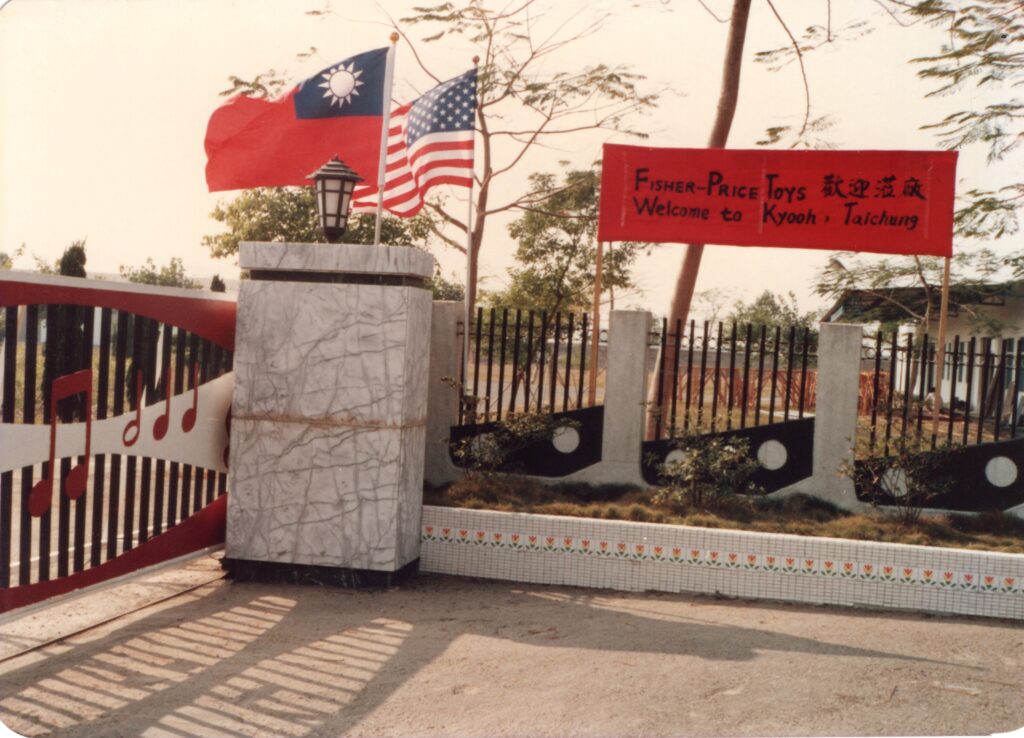
With both Taiwanese and American flags displayed, the banner reads “Fisher-Price Toys welcome to our factory” and “Welcome to Kyooh, Taichung.” In its early years, Kyooh had a partnership with the renowned American children’s toy brand Fisher-Price.
This photo shows the entrance of Kyooh’s factory, with both Taiwanese and American flags and a banner welcoming Fisher-Price Toys to Taichung. Fisher-Price is a well-known American brand for infant and toddler toys—familiar to nearly every household with children. The image reflects Kyooh’s involvement in the global toy industry.

Rewinding to the 1970s, the global demand for music box movements was around 98 million units per year, with Taiwan being the world’s largest market, accounting for about 30 million units on its own. Notably, this demand was for export rather than domestic consumption. Taiwan served as the final assembly hub, importing music box movements from Japan or Malaysia. Once installed into crystal balls or doll bodies, they became complete music boxes ready for export worldwide.

This aligned perfectly with Taiwan’s industrial structure at the time: the country had skilled yet affordable labor, allowing imported machine-made components to be assembled domestically at low cost and then re-exported.

Representatives from Fisher-Price Toys visiting Kyooh’s factory. In its early years, Kyooh had a partnership with the renowned American children’s toy brand Fisher-Price.

At the time, Japan had overcome the technical limitations of mass-producing music box movements. Much like today’s low-cost music box exports from China, Japan used aggressive price competition to devastate all European and American music box manufacturers. Led by Sankyo, five Japanese companies in total—Toyo, Sanyo, Sanshin, Shimizu, and Sankyo—dominated the market, controlling 95% of the global music box industry. But this situation was about to change.

Sankyo Seiki Mfg. Co., Ltd.’s Presence in Taiwan

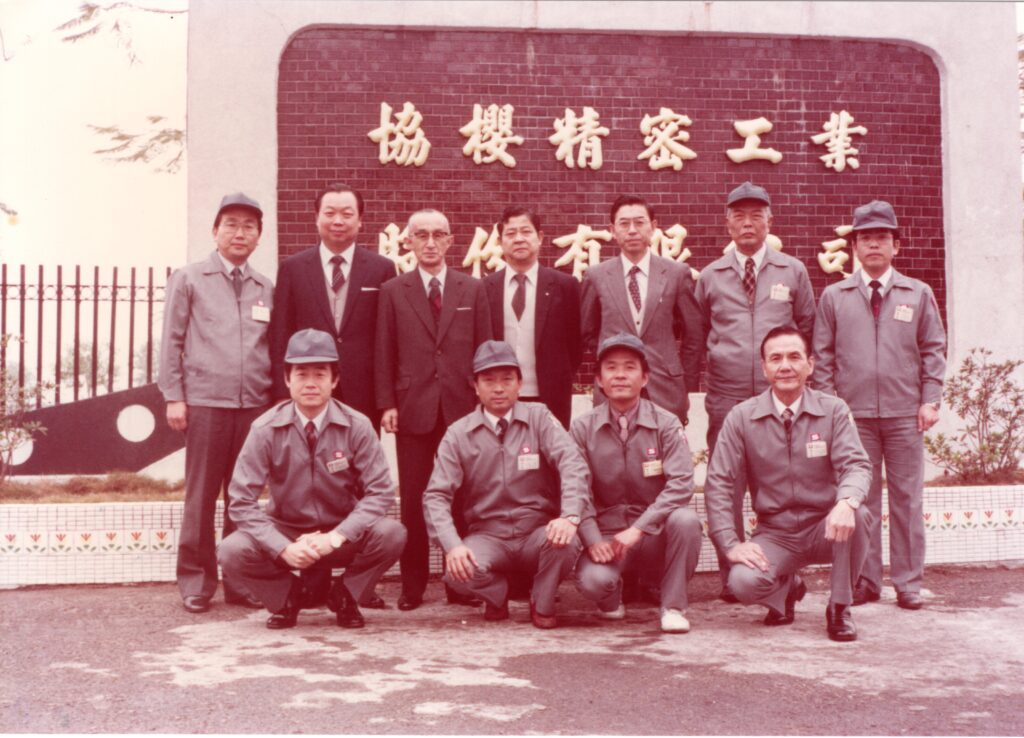
Sankyo President Rokuichi Yamada visits Kyooh and poses for a commemorative photo with the management team.
This photo was taken during the visit of Sankyo President Rokuichi Yamada to Kyooh, capturing a group photo with the company’s management. Back row from left: Kyooh’s second general manager Okubo Manabu, Chairman Lin Min-Shun, Sankyo President Rokuichi Yamada. Back row from right: Factory Director Ueda Fumiaki, Deputy General Manager Chen Shen-Tsung. Front row from right: General Affairs Chief Wu Shuang-Ying, Mechanical Section Chief Hung Xi-Chin, Manufacturing Deputy Manager Huang Long-Xi.

Sankyo’s sales department suddenly received critical information: since Taiwan was the world’s largest export-oriented music box assembly market in the 1970s, their four competitors were planning to join forces and build a large-scale music box production facility directly in Taiwan. If this is true, it would allow their rivals to further reduce production costs and immediately put Sankyo at a disadvantage in the price war. Although Sankyo had already established a production base in Malaysia, they now had to move quickly to set up a large-scale facility in Taiwan as well.

Reasons for Kyooh’s Factory Establishment and Its Site Selection Process

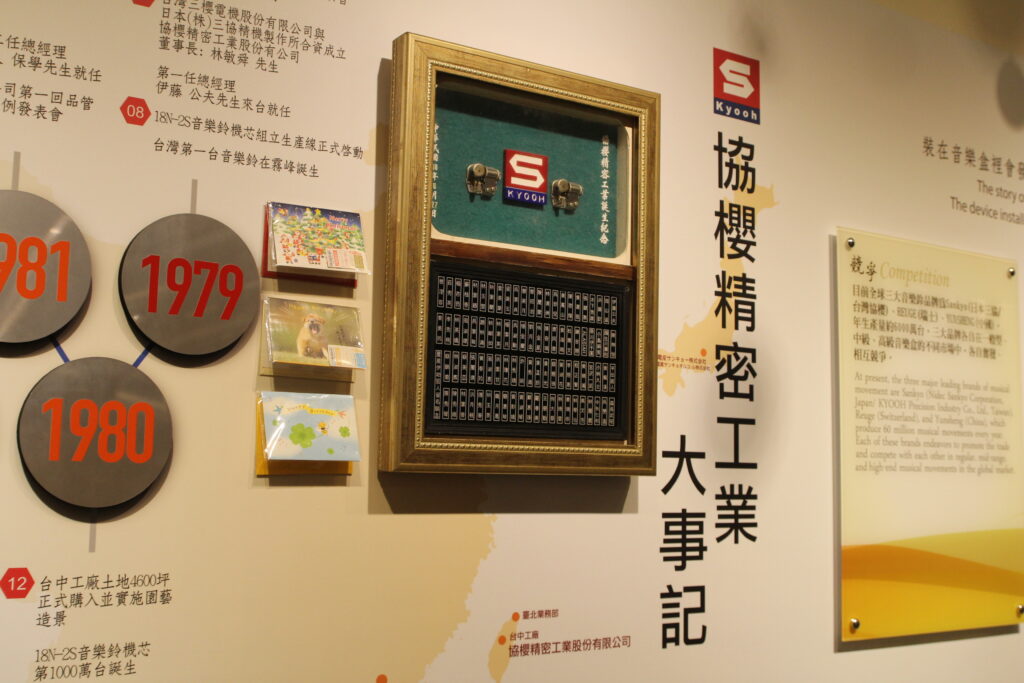
Commemorative plaque of Kyooh Precision Co., Ltd., featuring the first Taiwan-made Sankyo “2S” music box movements and the names of founding staff.
A commemorative plaque marking the founding of Kyooh Precision Co., Ltd., It displays two Sankyo “2S” music box movements—the first batch produced in Taiwan—and the names of 90 founding employees from 1979.

Due to Taiwan’s regulations at the time, wholly foreign-owned companies were required to export at least 50% of their products. Therefore, Sankyo’s new music box factory in Taiwan had to form a joint venture with a local company in order to sell 100% of its output domestically (sold to distributors, but ultimately exported).

At that time, Sankyo already had an investment in the Kaohsiung Export Processing Zone for producing home appliance components. They approached Taiwan’s Sanho Electric Co., Ltd., which had a technical partnership with Sankyo in timer manufacturing, hoping to leverage their local presence to establish a music box production base. By combining Sankyo and Sanho, the joint venture Kyooh Precision Co., Ltd. was officially founded.

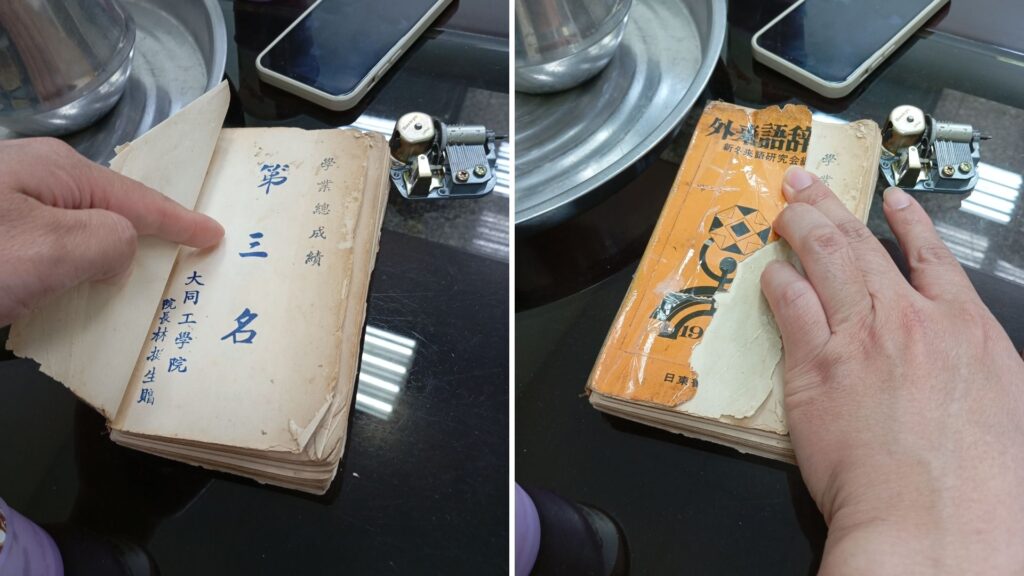
A well-worn Japanese dictionary gifted to President Huang, reflecting Kyooh’s deep ties to Sankyo Japan.
This image shows the Japanese dictionary gifted to President Huang upon completing his Japanese language training at Tatung Institute of Technology. During the interview, he retrieved the dictionary directly from his desk drawer—its worn cover reflects his dedicated Japanese study for years. His fluency enables seamless communication with Japanese partners. As Kyooh Precision traces its roots to Japan’s Sankyo, board reports are still written in Japanese, preserving this linguistic and cultural legacy.

Facing the urgent pressure of competitors planning to jointly produce in Taiwan, the preparation period for Kyooh’s factory was extremely short. Before Kyooh was founded, current General Manager Huang Long-Xi served as the technical section chief at Sanho. Due to a previous industrial design job, he had received three months of Japanese training at Tatung Institute of Technology. With only basic Japanese communication skills, he was sent to Japan for a 21-day internship and immediately returned to Taiwan to prepare for the factory. The company was established in April 1979 and began production by August, illustrating the urgency of the situation.

Mr. Lin Min-Shun, former chairman of Kyooh. His decision to co-found Kyooh Precision with Sankyo Seiki Mfg. Co., Ltd. marked the beginning of this chapter in Taiwan’s music box history.
This photo features Mr. Lin Min-Shun, former chairman of Kyooh. In 1979, he made the pivotal decision to co-found Kyooh Precision with Japan’s Sankyo Seiki Mfg. Co., Ltd., introducing music box manufacturing technology to Taiwan. His leadership laid the foundation for the brand and began this chapter in Taiwan’s music box history.

Initially, Kyooh searched for a factory in the Wugu Industrial Zone in Taipei. However, the existing buildings there had columns in the middle of the floors, leaving insufficient straight-line space for production lines, which did not meet the Japanese side’s requirements for music box assembly workflow. Eventually, because Kyooh’s chairman at the time, Mr. Lin Minshun, was from Wufeng, the company decided to look for a suitable site there. Coincidentally, Dechang Construction was planning the Nanshi Industrial Zone in Wufeng, so after several considerations, Kyooh ultimately settled there.

Negotiations over Management Control between Sankyo and Kyooh

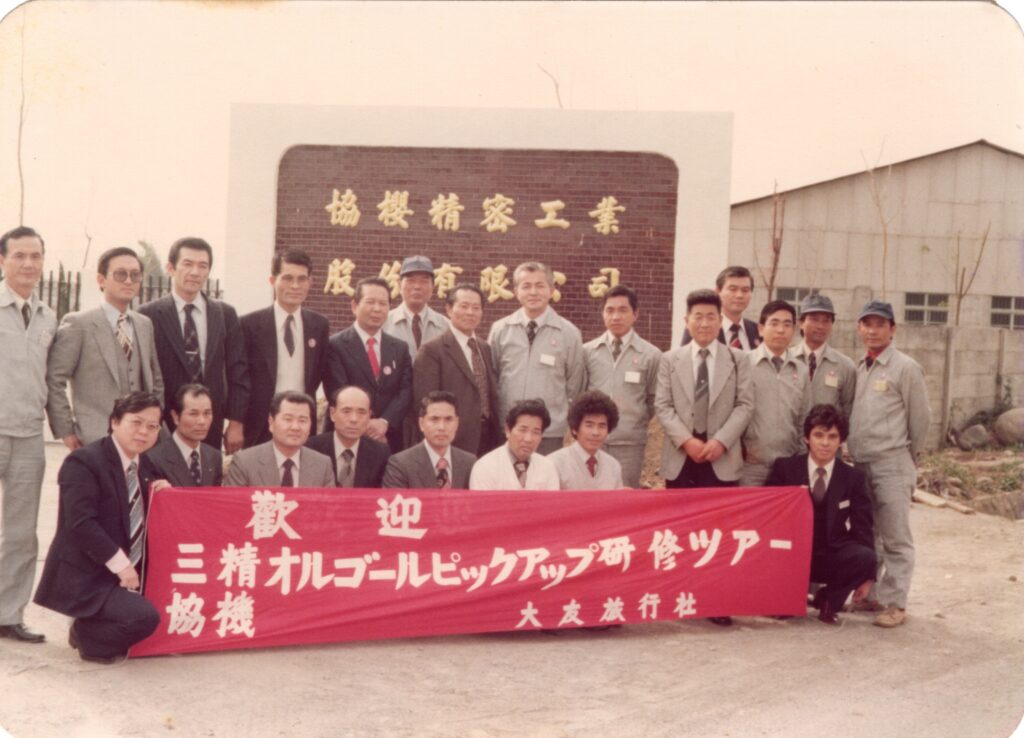
Sankyo staff visiting Kyooh, with a banner reading “Welcome Sankyo Music Box Training Tour”—a sign of formal reception.
This photo was taken during Sankyo’s visit to Kyooh’s factory. The banner reading “Welcome Sankyo Music Box Training Tour” reflects Kyooh’s formal reception of the Japanese guests. The visit allowed Sankyo representatives to observe the music box production site and its achievements.

Under Taiwan’s old Company Law, foreign investors in joint ventures could not hold more than 49% of shares, so Sankyo’s initial stake was 49%, below the majority. However, as music boxes were Sankyo’s founding product, the Japanese side was well-versed in management practices for this business. After negotiations with the Taiwanese partners, Sankyo effectively obtained operational control.

As a result, positions from general manager to factory manager and department heads were long-term assignments of Japanese personnel. Japan also regularly sent staff to Taiwan for support and training—periods ranging from three to six months. Although General Manager Huang Longxi was responsible for establishing the factory in Taiwan, his initial title was only “Manufacturing Section Chief.” This reflected the technological advantage of Japanese manufacturing, meaning that even with a majority stake, Taiwanese partners had limited operational influence in boardroom decisions.

The first several general managers of Kyooh were Japanese. The fourth general manager, Matsushima Hiroshi, was transferred from Sankyo’s Malaysia plant, where he had worked for six years, and then served as Taiwan GM for nine years. The sixth general manager came from Sankyo’s Guangzhou plant. The current general manager, Huang Long-Xi, assumed the role in 2004 as the seventh GM and continues to serve today.

Kyooh’s Early Production Scenes

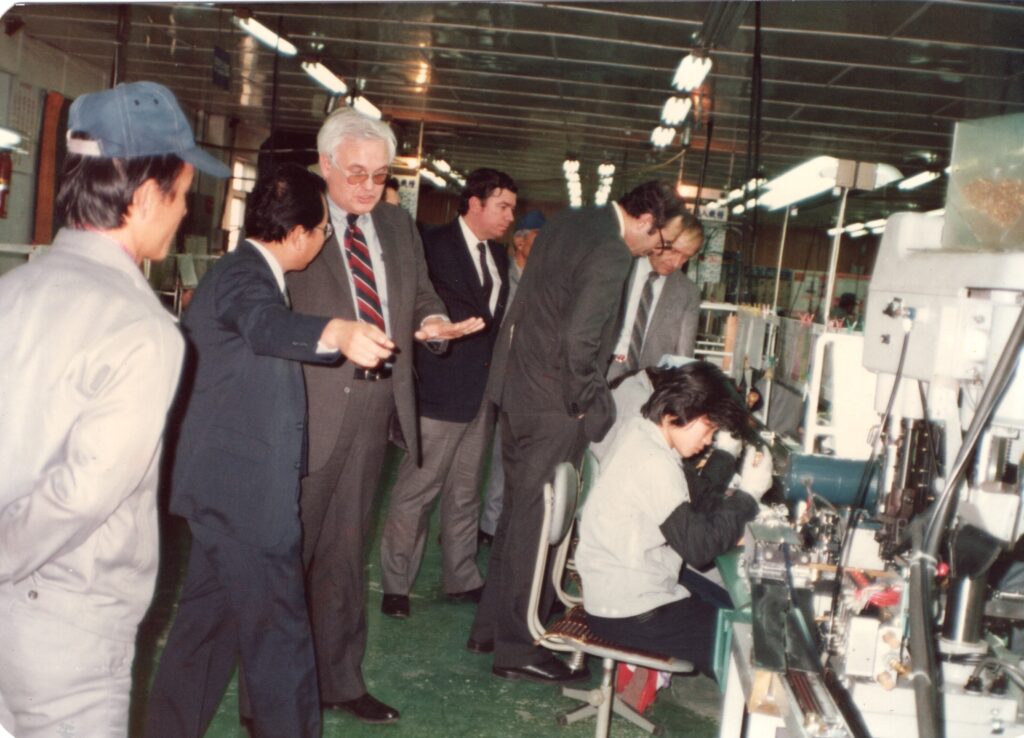
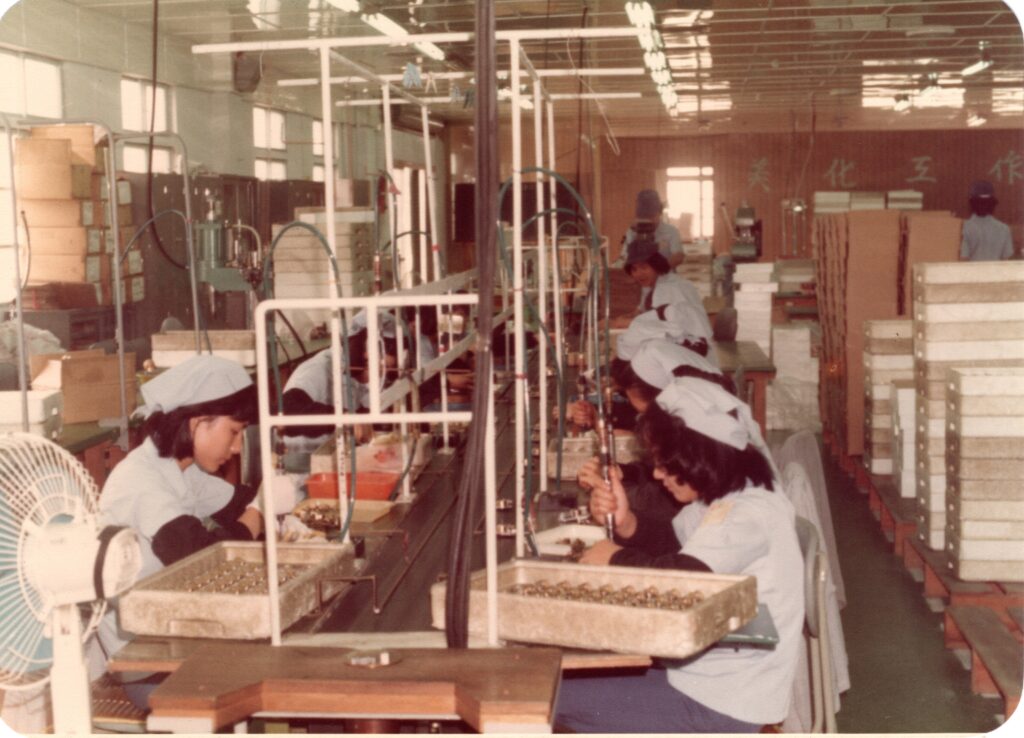
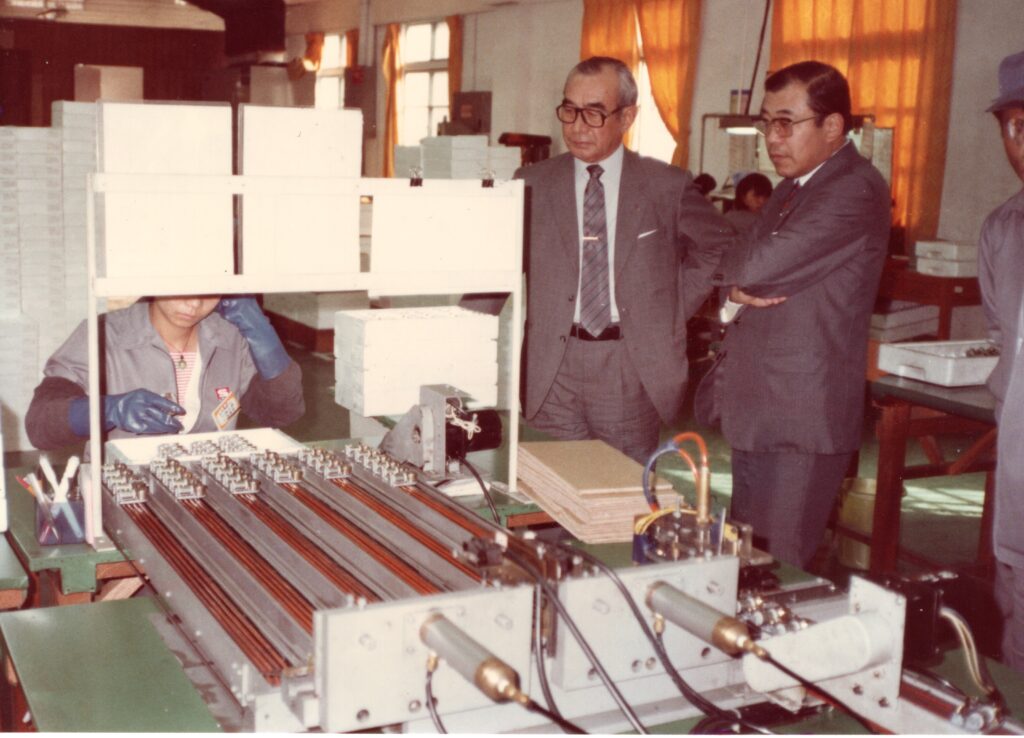
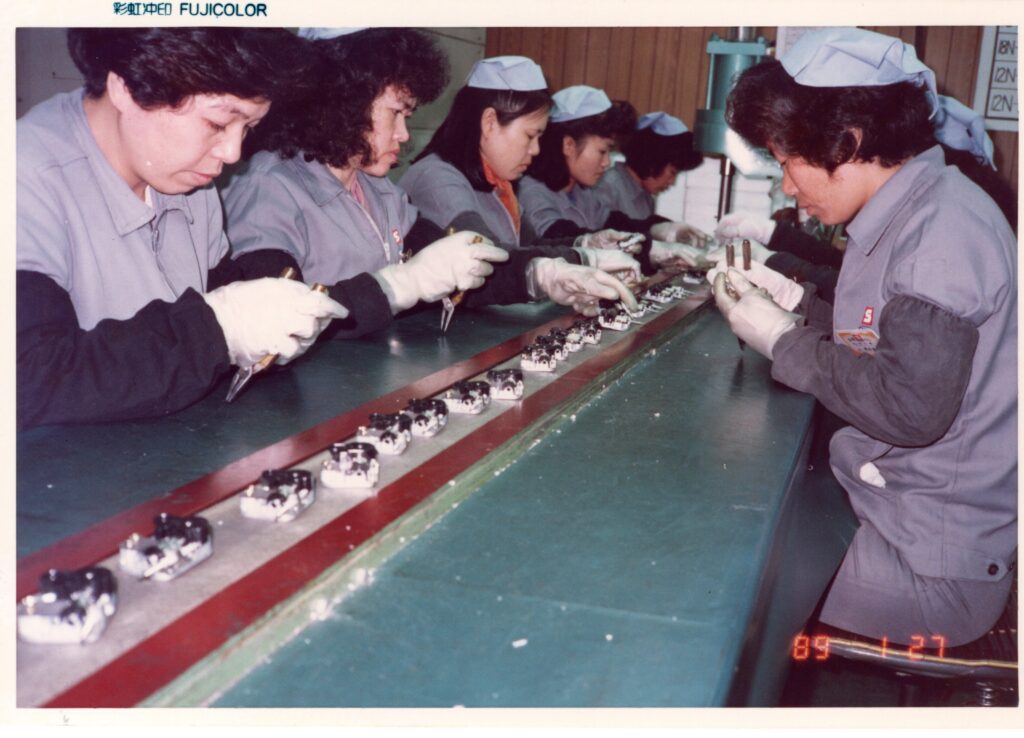
Early assembly scene at Kyooh, showing the production workflow and focused expressions of factory staff.
This photo captures the early assembly environment at Kyooh, highlighting the factory’s internal workflow and the dedication of its workers.

In its early days, Kyooh’s main business was assembling music box movements, without producing any components—all parts were imported from Japan.

Despite being assembly-only, the Japanese side was very concerned. The factory had been set up in a hurry, and the Malaysia plant had taken six years without turning a profit. The Japanese assumed Taiwan would face a similar situation, creating an atmosphere of extreme pessimism.

Unexpectedly, Kyooh began operations in August 1979, and by the end of the fiscal year in December—just five months later—the company had earned NT$6.8 million! This likely reflected a fundamental difference in worker efficiency. When asked about the reason, the general manager revealed how they had selected their operators at the time.

A Unique Approach to Talent Selection

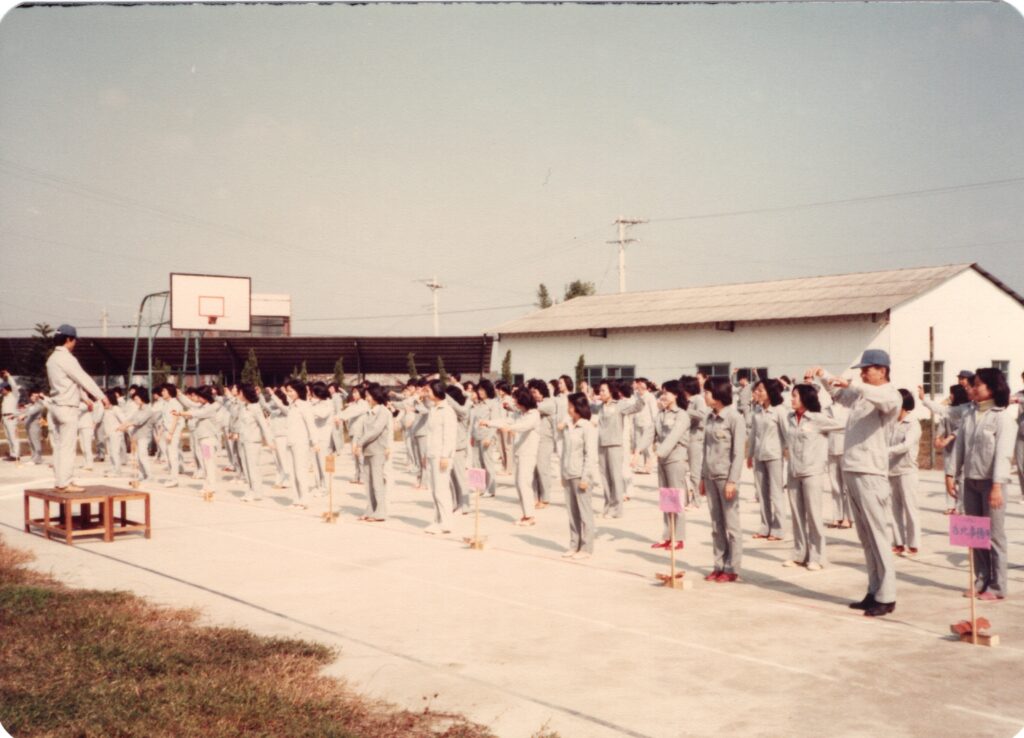
At 10 AM, music played over the loudspeakers and employees stood up to do morning exercises. This photo likely shows a group activity day, with everyone gathered on the playground.
This photo captures Kyooh’s early morning exercise routine. At 10 AM, music would play over the loudspeakers and employees would stand up to stretch and move. The image likely shows a group recreation day with everyone gathered on the playground. Although I was curious about the song used, the general manager shyly declined to reveal it. Today, Kyooh no longer requires morning exercises, making this a nostalgic glimpse into the past.

The general manager mentioned that during operator interviews, he would take black and white Go (the board game) stones, mix them together, and ask candidates to pick black stones with their left hand and white stones with their right hand simultaneously. They had to sort and neatly place the stones into the squares of a Go board. The number of stones placed and the tidiness within a set time were then assessed. Using this unique selection method, all Kyooh operators were quick-eyed, nimble-handed, and meticulous—no wonder the company achieved profitability in just five months!

A Relationship of Collaboration and Calculated Strategy with Japan

The main gate of Kyooh in its founding years. By retaining early profits to purchase land and facilities, the company can still care for its team and preserve Taiwan’s music box legacy—even as the industry fades.
This photo shows the front gate of Kyooh Precision in its early days. At the time, the Taiwanese side insisted on retaining initial profits to purchase land and facilities, rather than returning them to shareholders. Decades later, as the music box industry wanes, this decision enables Kyooh to continue supporting its team and establish a museum to preserve Taiwan’s music box history.

From the first year in 1979, Kyooh earned NT$6.8 million in just five months. In the second and third years, profits soared to NT$20–30 million annually. However, earnings gradually declined: in the fourth year, profits dropped to just over NT$10 million and continued to decrease slightly each year thereafter.

Why? Because production management was entirely assigned by the Japanese side, giving them full visibility of the cost structure. Initially, all raw materials for the music box movements were purchased from Japan. When the Japanese were surprised by the high profitability of the Taiwan plant, they began adjusting export prices of Japanese parts year by year, which gradually reduced Taiwan’s profit margins. In response, the Taiwanese partners launched aggressive cost-improvement initiatives.

Fortunately, the Taiwanese shareholders had insisted on retaining early profits to purchase the factory and land currently in use. This preserved the company’s foundation, allowing Kyooh to maintain valuable assets even after the music box boom faded, providing a safeguard that helped the company weather future challenges.

“2S”: Sankyo’s First Music Box Produced in Taiwan

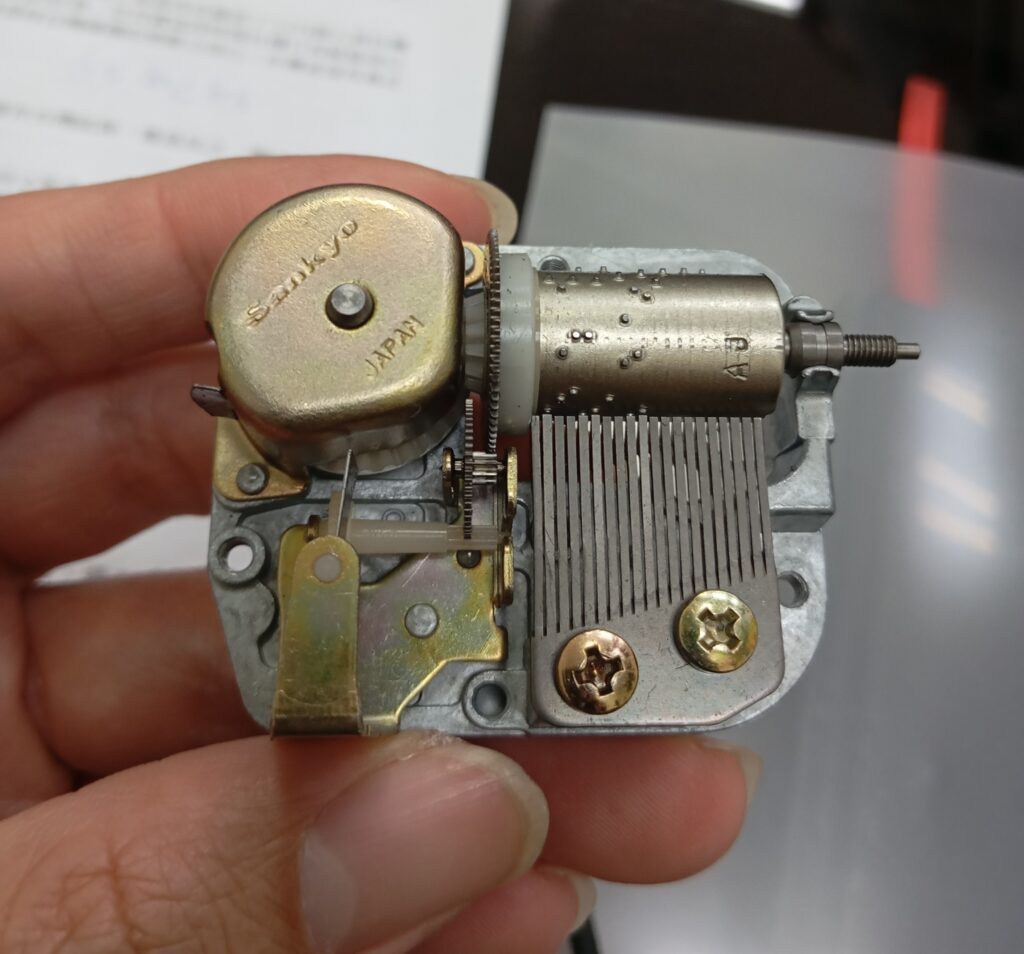
The Sankyo “2S” movement features metal gears and a sheet-style governor, reflecting early mechanical craftsmanship.
This image shows the Sankyo “2S” music box movement, notable for its metal spring barrel and gear components. Its most distinctive feature is the sheet-style metal governor, which comes in various specifications. During assembly, the appropriate governor must be selected based on the tempo of the music to ensure accurate and stable playback.

Sankyo’s first-generation music box model was designated “1S”, with a cast iron base. However, cast iron lacked the precision needed for automated production, so it was later replaced with die-cast zinc alloy. This solved the precision issue and was coded as “2S”, becoming the main music box model for Sankyo at the time. (Note: The “2S” model is identifiable by the fact that all its components are made of metal; the movement is entirely metal.)

The first model produced by Kyooh was the “2S” (the one displayed on the wall at the Wufeng Music Box Museum as the “Factory Opening Commemoration” is a 2S). Sankyo allowed the 2S to be produced in Taiwan because the Malaysia plant’s capacity was insufficient to meet market demand, and Taiwan could help reduce Japan’s high labor costs. Initially, the Taiwan plant only performed assembly—it did not manufacture parts. Kyooh had no equipment like punch presses for production; all components were imported from Japan, and Taiwan’s role was to assemble and ship the completed movements to distributors and music box manufacturers.

Localization of the “2S” Music Box in Taiwan

After establishing its mechanical division, Kyooh introduced stamping technology to produce music box cylinders.
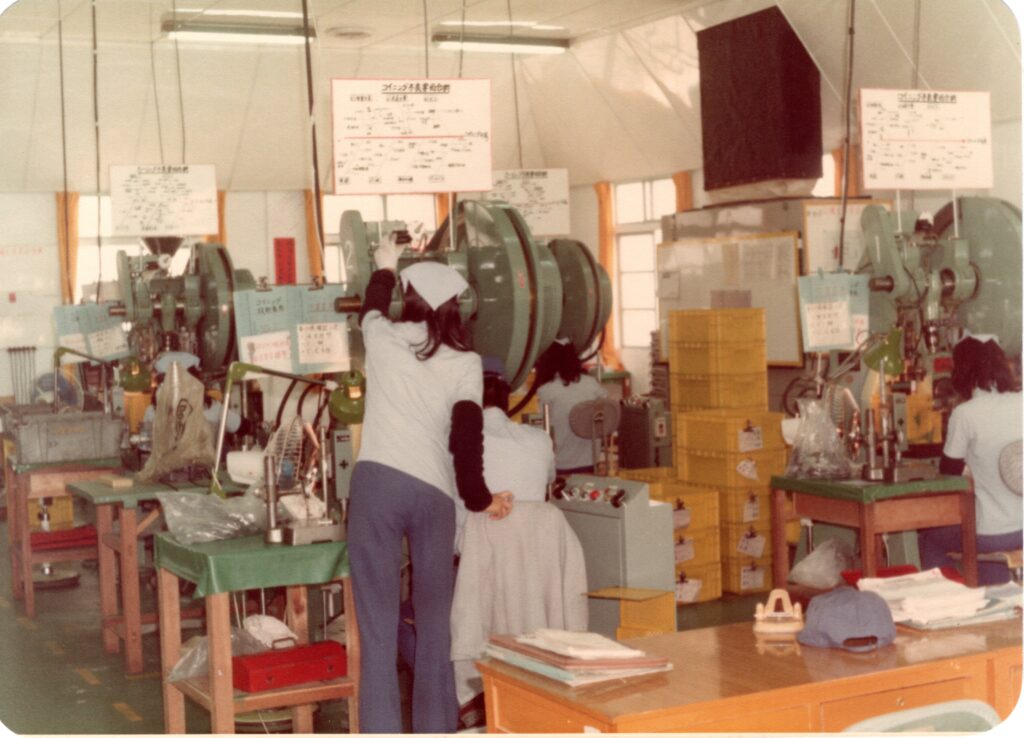
This photo was taken after Kyooh’s second year, when the company established its mechanical division and began using stamping machines to mass-produce music box cylinders. This move improved manufacturing efficiency and laid the foundation for Kyooh’s expertise in music box component processing. The image shows staff operating stamping equipment, offering a glimpse into early factory operations.

In 1979, the first year of Kyooh’s establishment, the company was only responsible for assembling movements, with all production lines and components imported from Japan. It wasn’t until the second year that Kyooh established a “Mechanical Department.” Initially, punch presses were used to produce the “music cylinders,” and later, die-cast zinc alloy production for the bases began in collaboration with Hexing Precision Metal Casting in Taipei, adding processes like tapping and drilling on the bases. Except for the vibration plates, which still needed to be imported from Japan, the rest of the components began to be locally manufactured in Taiwan.

However, punch press molds for the music cylinders still had to be imported from Japan due to the specialized music encoding techniques and the precision required for music box movements—a practice that continues to this day. As for zinc alloy base molds, the process started with Japanese molds, then gradually shifted to local production trials in Taiwan. These trial molds were sent back and forth to Japan for inspection and modification until they successfully passed Sankyo’s approval, allowing the use of locally produced zinc alloy bases.

Starting from Imitating Japan

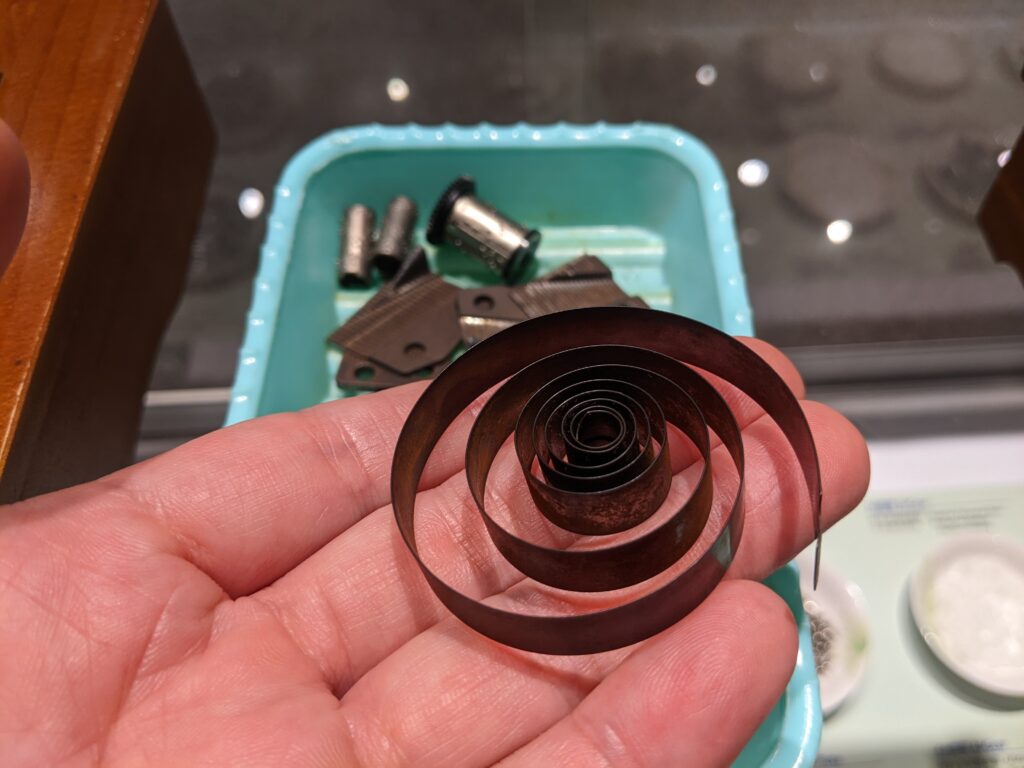
Spring motor for music box mechanism
This image shows the spring motor used in a music box. It stores energy when wound and gradually releases it to power the rotation, working in tandem with a governor to maintain consistent tempo. Sankyo music boxes originally used Japanese-made springs, but have gradually shifted to sourcing from Taiwan and mainland China for cost efficiency.

Rather than “developing” music boxes, the early work in Taiwan was really about “imitating” Japanese production. Japan provided the blueprints, and Taiwan had to follow them 100% in manufacturing. Even screws for the vibration plates were only sourced locally in Taiwan after several years. As for the music box springs, although the parent company Sanho already produced springs for timers, they were only later allowed to be used in music box components.

The real challenge was not a lack of technical ability in Taiwan, but the Japanese side’s extreme caution. Any design or production changes required repeated testing and careful evaluation. As a result, music box development was a gradual, highly controlled process under strict Japanese oversight—it wasn’t simply a matter of Japan setting up a factory and Taiwan immediately designing and producing music boxes independently.

Japan’s Ambition to Dominate with the “3S”

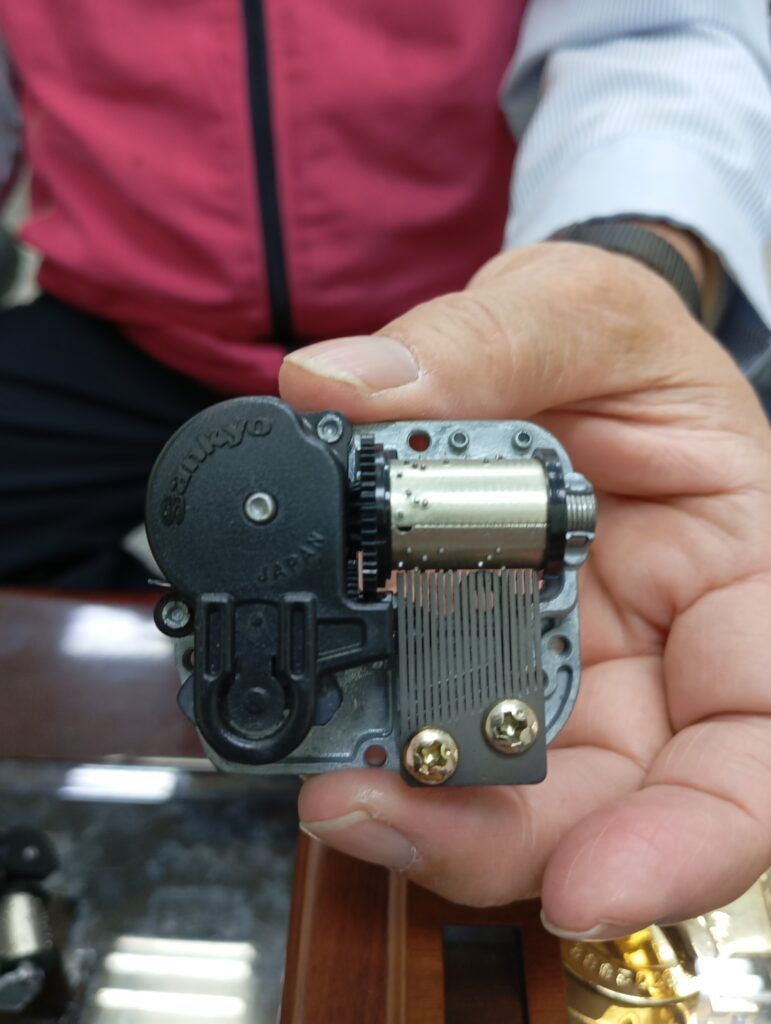
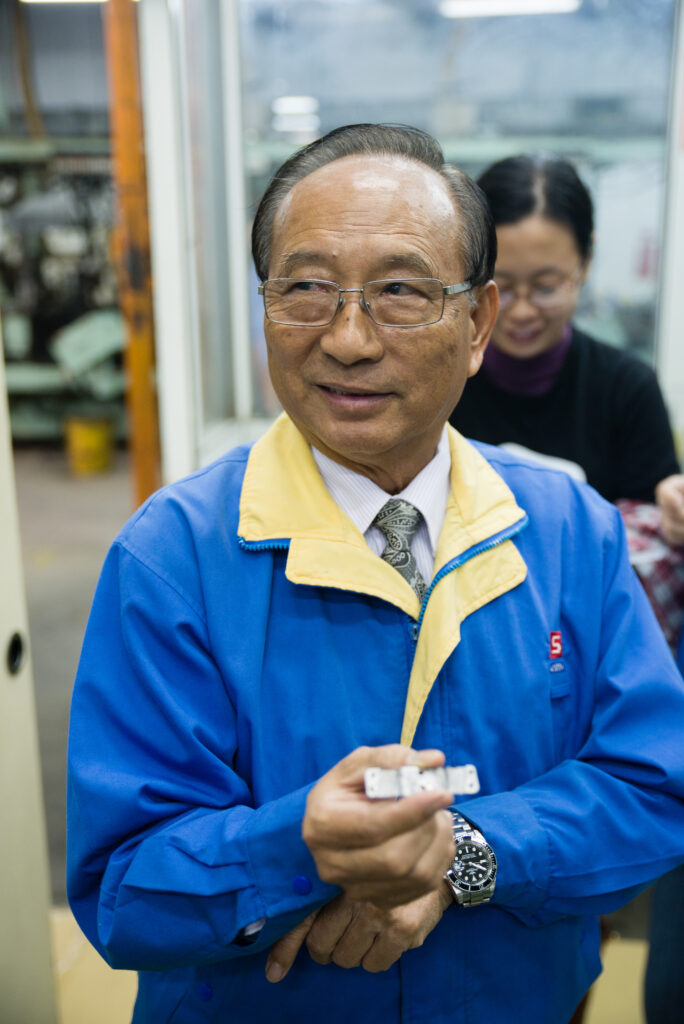
Mr. Huang showcases an early Japanese-made Sankyo “3S” movement, identified by its black spring cover and “JAPAN” marking.
The image features Mr. Huang holding a Sankyo “3S” music box movement. A key identifier of this early version is the black spring barrel cover and the engraved “JAPAN” mark, indicating its Japanese origin. In later production runs, after manufacturing shifted to mainland China, the country-of-origin marking was removed—making this detail a clue to its production era.

At that time, annual production of the 2S model in Japan was 12 million units, combined with 6 million from Taiwan and 6 million from Malaysia—a total of 24 million units. This still couldn’t meet Taiwan’s local demand of 30 million units, let alone the global demand of 90 million units. The supply-demand gap was enormous!

As a result, Sankyo began full-scale development of a fully automated model, designated “3S”, and launched a new round of rationalized design. The 3S featured a smaller overall movement, with the mainspring barrel and gears changed from metal to plastic. This reduced costs and made the movement more suitable for mass production. The fully automated 3S model also applied for invention patents in the United States, Japan, the EU, and other countries worldwide.

The Discontinuation Crisis of Taiwan’s “2S”

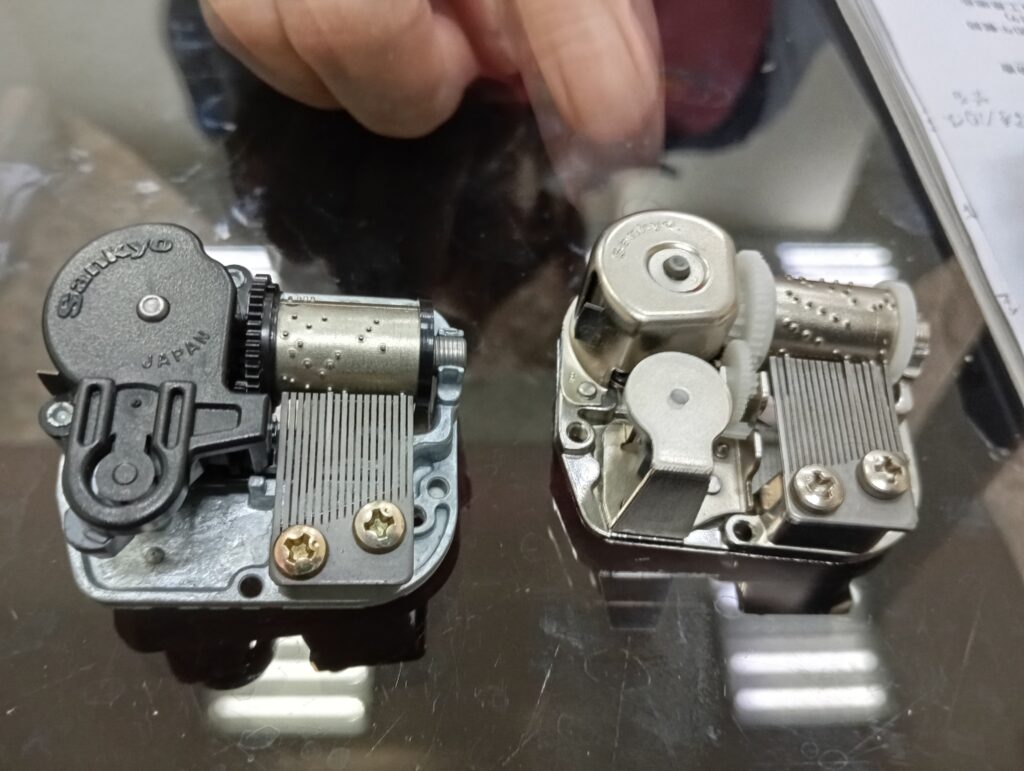
Left: Sankyo “3S” movement. Right: improved “2.5S” version with metal parts for plating and richer sound.
This image compares the Sankyo “3S” movement on the left with the improved “2.5S” version on the right. The “3S” model, known for its heavy use of plastic gears and governor to reduce costs, led to the development of the “2.5S” which retains metal components such as the spring barrel and governor bracket. These metal parts allow for electroplating in various colors. As noted by the general manager in an interview, heavier movements tend to produce fuller sound. Despite cost-saving improvements, older designs often deliver superior acoustic quality.

After full-scale production of the automated 3S began, even though Taiwan had started producing all 2S components locally, the production cost of Japan’s 3S was still lower than Taiwan’s 2S. Additionally, because the 3S had a heavy plastic feel, the metal finish of the older 2S movements remained appealing for music boxes with exposed movements. In response, Japan developed the “2.5S” model.

The 2.5S replaced all transmission gears with the plastic gears from 3S, while retaining the 2S base and metal mainspring barrel. This reduced costs while allowing the movement to be plated in various vibrant metallic colors.

To focus on promoting the new 2.5S and 3S models, Taiwan’s 2S product line was forced to be discontinued.

Introducing the “Mini Movement” Sparks a Financial Crisis

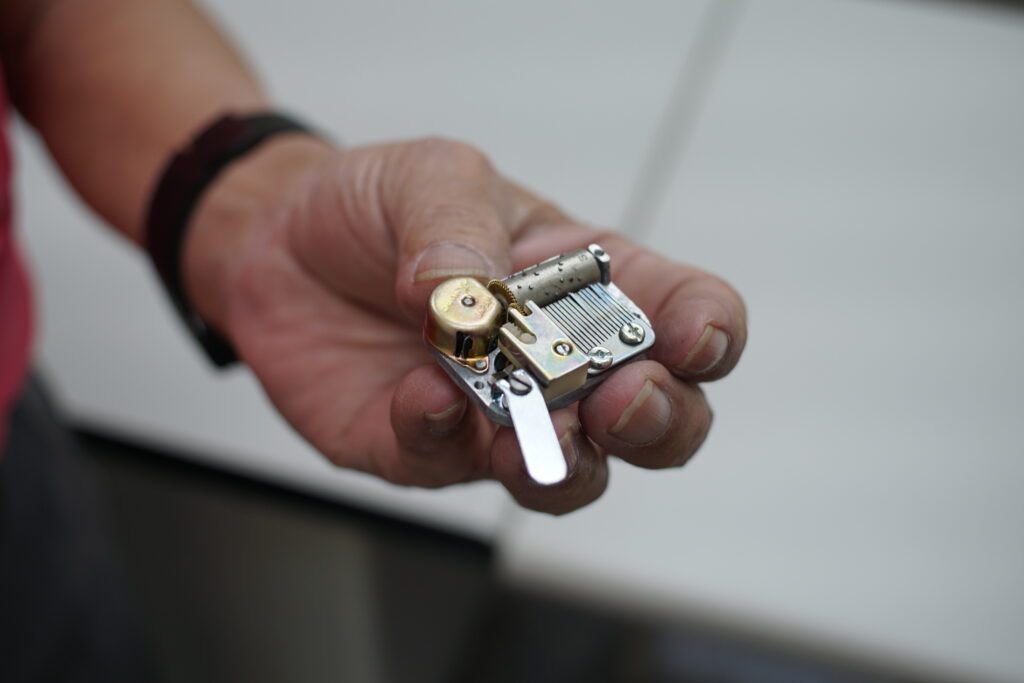
The mini music box movement in hand is the earliest version designed by Japan’s Sankyo, characterized by its mostly metal components.
This photo shows the earliest mini music box movement designed by Japan’s Sankyo. Most of its components were made of metal, reflecting the durability and craftsmanship of early manufacturing.

To fill the gap left by Taiwan’s discontinuation of 2S, Japan transferred the assembly line for the mini movement to Kyooh, though all components continued to be produced in Japan. At that time, annual sales of the mini movement were still around 4 million units.

Unexpectedly, after introducing the mini movement, Kyooh began incurring consecutive losses, accumulating nearly NT$60 million in three years.

The reason was contractual: Kyooh had to purchase each mini movement component set from Japan for NT$30, but the assembled units had to be sold back to Japan for only NT$28 (the numbers are illustrative for easy understanding).

In other words, after buying raw materials from Japan for assembly, Kyooh was forced to sell the finished product back at a loss. Simply calculating material costs, the company lost money on every unit—selling 4 million units meant a loss on all 4 million!

A Forced Loss-Making Transaction

At the time, General Manager Huang Long-Xi, then factory head, raised objections to the Japanese manager of Kyooh’s administration department, arguing that the arrangement was completely unreasonable—who would run a business this way? To his surprise, the manager replied that he had no choice, because the sets of components sold by Sankyo to Kyooh at NT$30 were themselves sold at a loss!

Who would believe such a claim? Who would deliberately set a loss-making price? The Japanese manager explained that the selling price was not based on cost, but on market-expected pricing. Although mini movements cost more to produce than 3S movements, their smaller size meant the finished music boxes were smaller, and customers’ expected price for them was lower. Hence, the price had to be set accordingly, or the product wouldn’t sell.

In reality, Sankyo’s use of market-expected pricing forced Kyooh to sell below direct cost, causing consecutive losses for Taiwan’s Kyooh.

Introduction of the 20-Note TDM Model

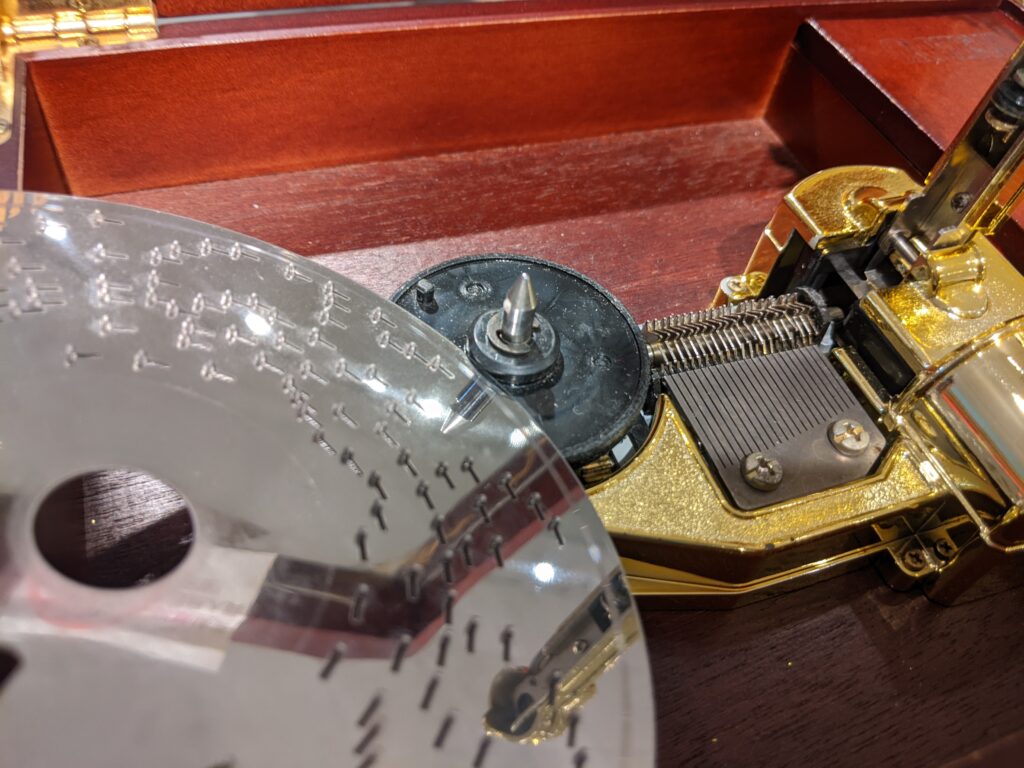
The rear view of a 23-note metal disc music box shows the embossed disc, star-shaped pawl, and motor housing.
A 23-note metal disc music box shows its rear disc and star pawl mechanism. The cylindrical cover on the right houses the motor. Originally designed in Japan and manufactured in Taiwan.

With the 2S discontinued and the mini movements incurring losses, what could Taiwan’s Kyooh do? The only option was to renegotiate with Japan and decide to introduce the TDM model to Taiwan.

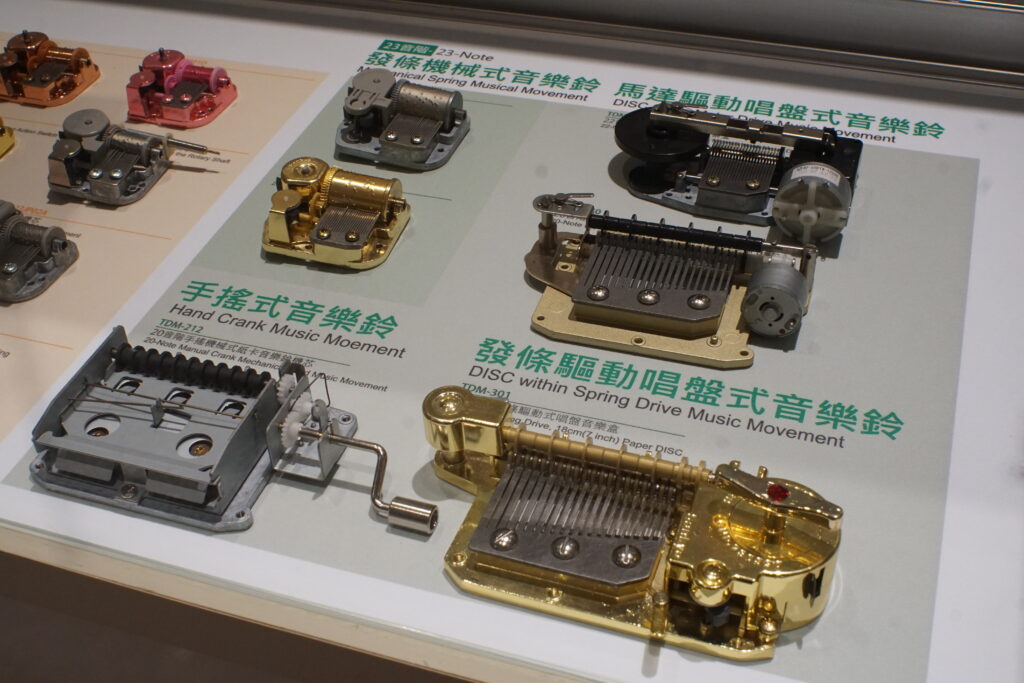
The TDM (MOTOR DRIVE DISC PLAYER) model is a 20-note, motor-driven music box, commonly seen as the disc-type music box. Later, paper strip music boxes were also categorized as TDM models, and the same vibration plate design was eventually used in Muro Box.

There is also a smaller stainless-steel disc version with more notes—22 in total—also classified under TDM. However, due to its smaller vibration plate, it doesn’t sound as full as the 20-note TDM.

For these TDM models, except for the vibration plates—which were produced in Japan and tuned in Taiwan—everything else, including the discs, was manufactured locally in Taiwan.

The main orders for TDM came from Sankyo’s Hong Kong branch, fulfilling orders for the U.S. brand Mr. Christmas, a well-known mail-order music box company. At its peak, orders for motor-driven TDM units reached as high as 150,000 per year.

Challenges with Mr. Christmas Orders

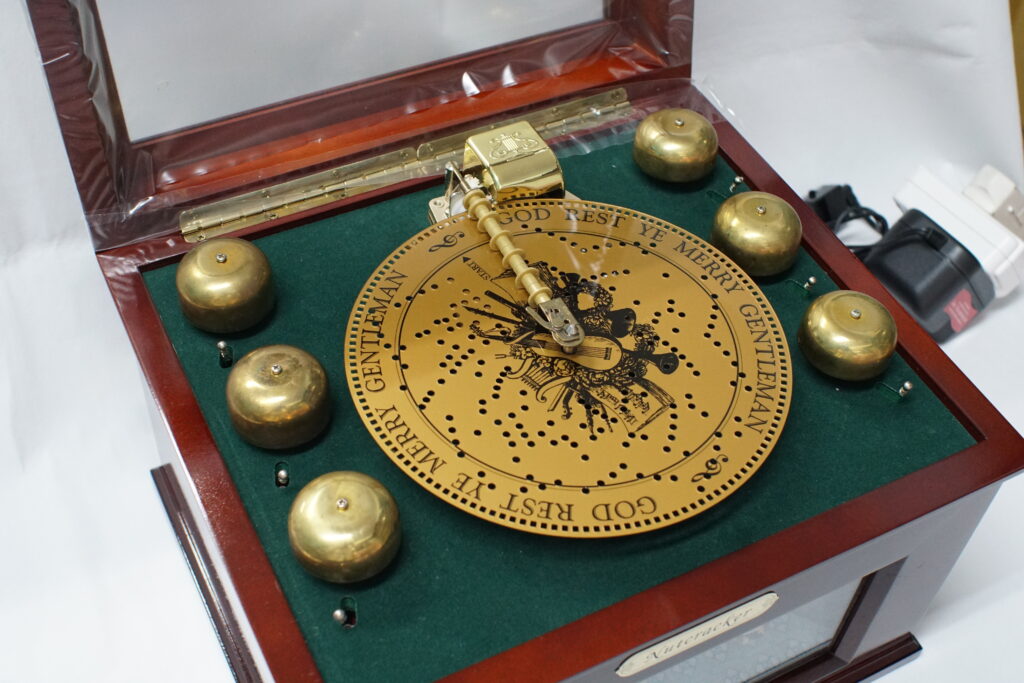
Mr. Christmas Grand Bell Symphonium from the Gold Label Collection with rotating bells and illuminated stage
Experience the elegance of Mr. Christmas’s Grand Bell Symphonium from the Gold Label Collection, featuring rotating bells, illuminated figures, and rich orchestral melodies.

However, fulfilling Mr. Christmas orders came with its own challenges. Their annual order of 150,000 units had to be delivered within just three months—May, June, and July. But the production speed of Japanese vibration plates was only 600 per day, requiring a total of 250 days to produce. This made it impossible to supply on demand, as the vibration plate capacity was too low.

The only solution was to pre-order the entire year’s required vibration plates, with Japan delivering them gradually each day. This, however, resulted in nearly a year’s worth of inventory sitting at Taiwan’s Kyooh, placing additional pressure on cash flow.

The Japan Trip for Mini Movements

GM Huang Longxi holding the semi-finished vibration plate of the mini movement. When the company faced losses, he stepped up—embodying Taiwan’s fighting spirit.
This photo shows GM Huang Longxi holding a semi-finished vibration plate of the mini movement. At a time when the company faced serious losses, he—then the factory director—stepped forward while others remained silent, trying to turn things around. His courage and sense of duty reflect the true spirit of Taiwanese perseverance.

Meanwhile, the mini movements continued to incur losses, and the TDM model couldn’t make up for them—the company was barely hanging on. After much consideration, General Manager Huang (then factory head) refused to believe that the mini movement components were being sold at a loss to Kyooh in Japan, and kept raising the issue. Unable to convince the Taiwanese side, Sankyo finally said:

“Mr. Huang, if you don’t believe it, you are welcome to come to Japan and see for yourself.”

Japan Was Really Selling Mini Movements at a Loss

“In December that year, it snowed, and I resolutely went to Sankyo’s Shimosuwa factory in Japan. They opened up their computer and went through each part one by one, showing how many units they could produce per hour, the material cost for each, the processing cost…

Sure enough, the total cost added up to over 30 yen, so selling them to us for 30 yen was indeed at a loss!”

So, what could be done?

Transferring Mini Movement Production to Taiwan

General Manager Huang Longxi in Japan. After completing the mini movement development, he visited Japan to inspect automated vibration plate production and brine recycling equipment.
Taken after the mini movement was completed, this photo shows General Manager Huang Longxi visiting Japan to inspect automated vibration plate production. On the left is Mr. Huang, and on the right is the brine treatment manufacturer. The mini movement’s comb tuning uses computer-controlled chemical etching, with brine as the conductive medium, prompting a visit to a brine recycling equipment supplier.

“Mr. Huang, why not move the specialized equipment for mini movement production to Taiwan? Wages are lower there, so costs should decrease.”

“But we can’t just send the machines over. They need to be refurbished, and old parts replaced. That alone would cost around ¥70 million. Additionally, machines shared with the 3S cannot be moved; new machines would need to be custom-made, costing another ¥70 million.”

This meant an investment of over ¥100 million. Taiwan’s factory didn’t even have enough space, requiring a new building. Even without considering equipment costs, if the machines were actually moved to Taiwan, how much production cost could really be saved?

A Loss-Making Task That Couldn’t Be Avoided

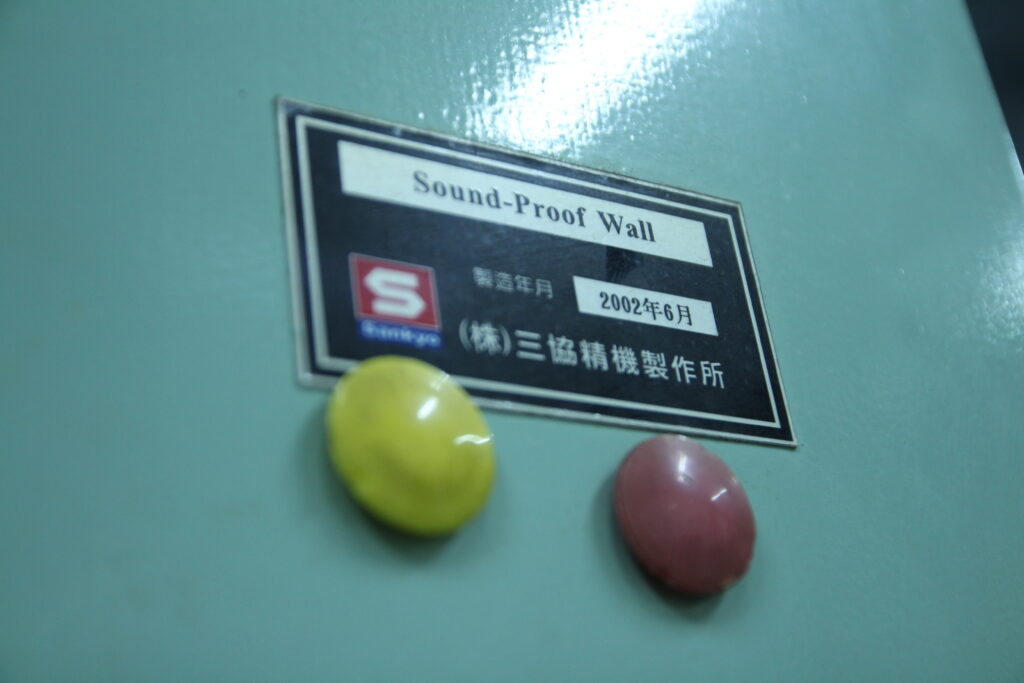
Nameplate on Kyooh’s soundproof wall featuring the “S” logo and Sankyo Seiki’s inscription, reflecting its role as Sankyo’s licensed production base in Taiwan.
A nameplate on the soundproof wall of Kyooh Precision Industry Co., LTD bears both the “S” logo and the name of Sankyo Seiki, highlighting Kyooh’s role as Sankyo’s licensed production and operational extension in Taiwan.

After careful calculation, production costs could only be reduced from over 30 yen to 28.5 yen per unit. But the selling price to Japan was 28 yen, meaning that even if the components were produced in Taiwan, Kyooh still lost 0.5 yen per unit!

Kyooh faced only two options: either abandon mini movement production and focus solely on the TDM model, which still had annual orders of 150,000 units and remained profitable, or continue producing mini movements at a loss.

However, the Japanese side would not agree. Sankyo still had millions of mini movement orders each year and needed someone to manufacture them. But producing them meant a guaranteed loss. Kyooh’s capital was NT$20 million, and losses had already accumulated to nearly NT$60 million—continuing was simply unsustainable.

Taiwan Develops Its First Original Music Box Movement

Mr. Chin-Tsai Chang holding the miniature music box movement he personally designed.
This photo was taken inside the Kyooh Music Box Museum, showing Mr. Chang Chin-Tsai holding the miniature music box movement he designed. Back then, known as Section Chief Chang, he collaborated with then Factory Director Mr. Huang Lung-Hsi to develop a new miniature movement. Today, Mr. Chang serves as Kyooh’s current Factory Director. If you happen to meet him at the museum, don’t miss the chance to hear his story firsthand.

Since Japan wouldn’t agree, Kyooh had no choice but to take the second path: redesign the mini movement in Taiwan without Japanese interference.

Previously, even changing a supplier required five to six months of approval from Japan, but if things continued that way, Kyooh would have no chance to solve the problem.

“I’ll figure out how to reduce costs myself, but don’t interfere. I’ll take full responsibility for the outcome.”

In fact, before traveling to Japan, the general manager (then factory head) had already planned the redesign, which gave him the confidence to insist on no interference. With no other options, Japan ultimately agreed.

Upon returning to Taiwan, the general manager immediately hid in the development room with Section Chief Chang to start working.

“I told them, if you want to reach me, you only have half a day—mornings don’t count. I’m responsible for developing the new mini movement with Chang!”

“Actually, it was quite simple. I just learned from the 3S approach. They switched from metal to plastic, so why can’t I? The gears were originally metal; in the mini movement, they were metal too. I just changed them to plastic!”

The “All-in-One” Design Concept

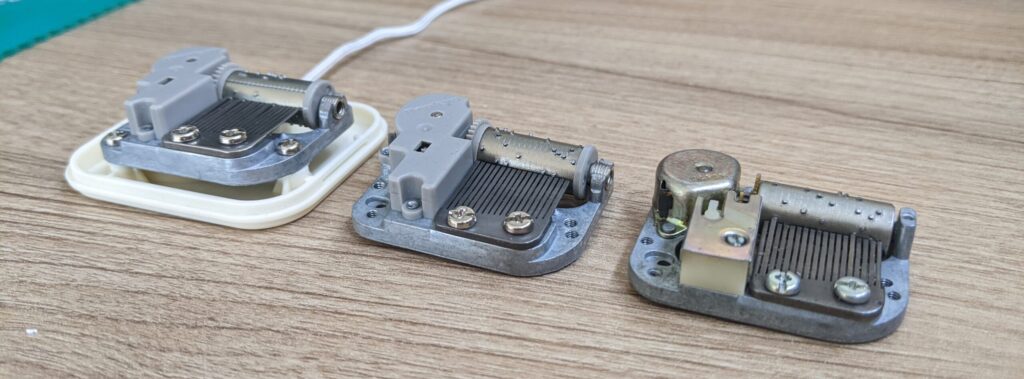
Side-by-side comparison of three mini music box movements: Sankyo’s original design (right), Kyooh’s improved version (center), and the assembled pull-string music box in plastic casing (left).
Evolution of mini music box movements: Sankyo’s original (right), Kyooh’s improved version (center), and the pull-string music box in plastic casing (left). Kyooh’s design replaces metal with plastic and reduces part count to cut costs.

The general manager explained that Japanese developers had a common trait: at the start, they designed products as if to protect themselves—making them extremely sturdy and “perfect”—then only gradually rationalized the design. By the time costs were significantly reduced through rationalization, many years had often passed.

Back in Taiwan, it took about six months to completely redesign the mini movement. Just then, Japan sent a message:

“Okay, even though you asked us not to interfere, can we offer support?”

“Support is fine, of course,” he replied.

So Japan sent an engineer to assist Kyooh. Although the new mini movement design was already nearly complete, it was still useful for them to observe and provide input.

A Culmination of Taiwan-Japan Collaboration

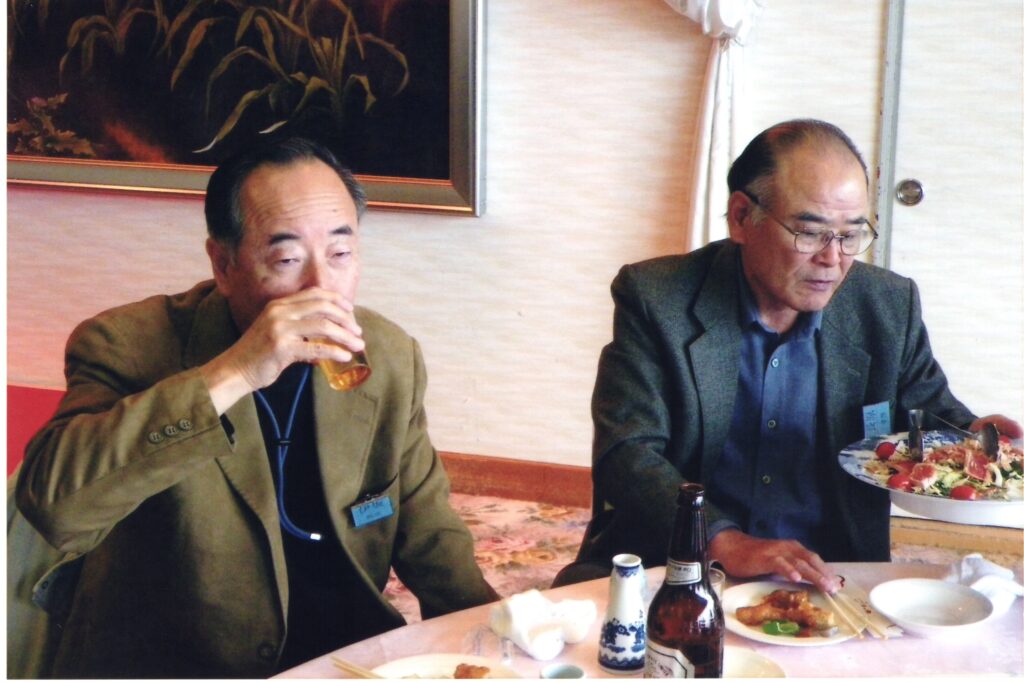
The photo was taken in 2008 at Nidec Sankyo’s Music Box Alumni Gathering. On the left is Isaka Akihiko, designer of the 3S music box movement.
This photo was taken in 2008 at the Nidec Sankyo Music Box Alumni Gathering (オルゴールのOB会). On the left is Isaka Akihiko, the designer of the 3S music box movement. Unfortunately, no photos were taken during his visit to Taiwan, as he was fully focused on work.

Who was this engineer? He was Mr. Isaka Akihiko, the Japanese Sankyo designer of the 3S model. He stayed for two weeks, spending days discussing the design with Kyooh and evenings being taken out to dinner and escorted back to his hotel. During those two weeks, the entire mini movement design was thoroughly revised and refined.

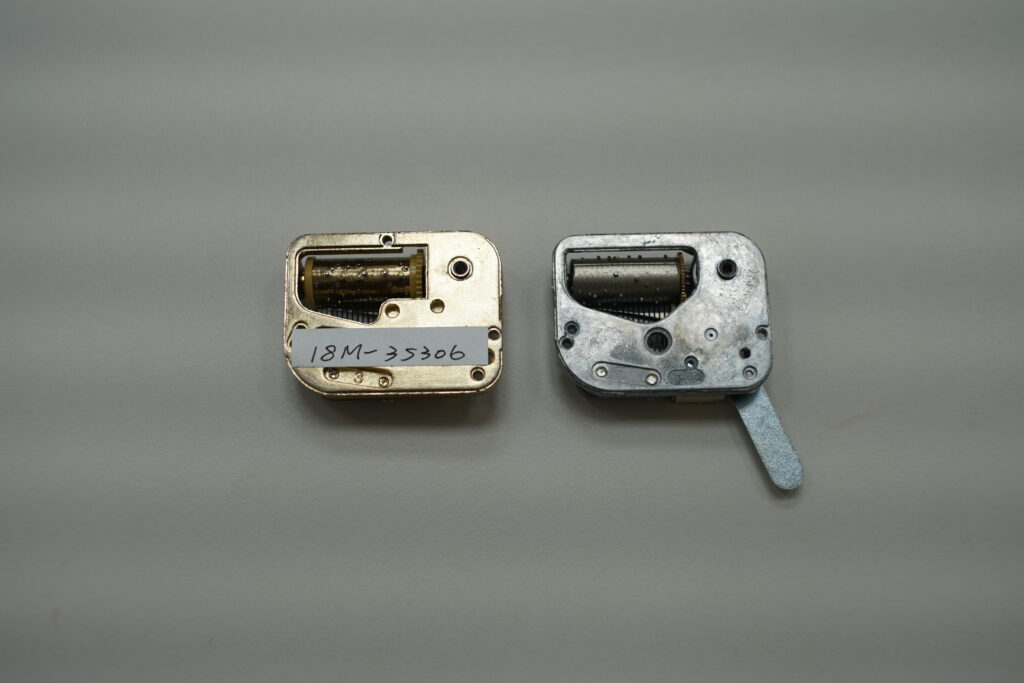
Left: Kyooh’s newly designed miniature movement; Right: original version by Japan’s Sankyo.
This photo compares the rear design of old and new miniature music box movements. On the left is Kyooh’s newly designed version, while the right shows the original model by Japan’s Sankyo. Though the differences may seem subtle at first glance, Kyooh’s redesign significantly simplified the component structure of auxiliary parts, reducing manufacturing complexity and cost—an achievement in technical refinement.

The main modifications focused on the accessories of the music box movement, such as the side and central rotating components. Originally, the base required an additional metal plate, which had to be punched and fitted with multiple transmission gears. With many different models, each required its own specification for the added plate and base.

So they brought all the models together and integrated the areas requiring the extra punched metal plates into the new base. As a result, for essentially all accessory models, there was no longer a need to add that extra metal plate—parts could simply be placed and used.

“This modification significantly reduced costs.”

Business Strategy to Protect Taiwan’s Profits

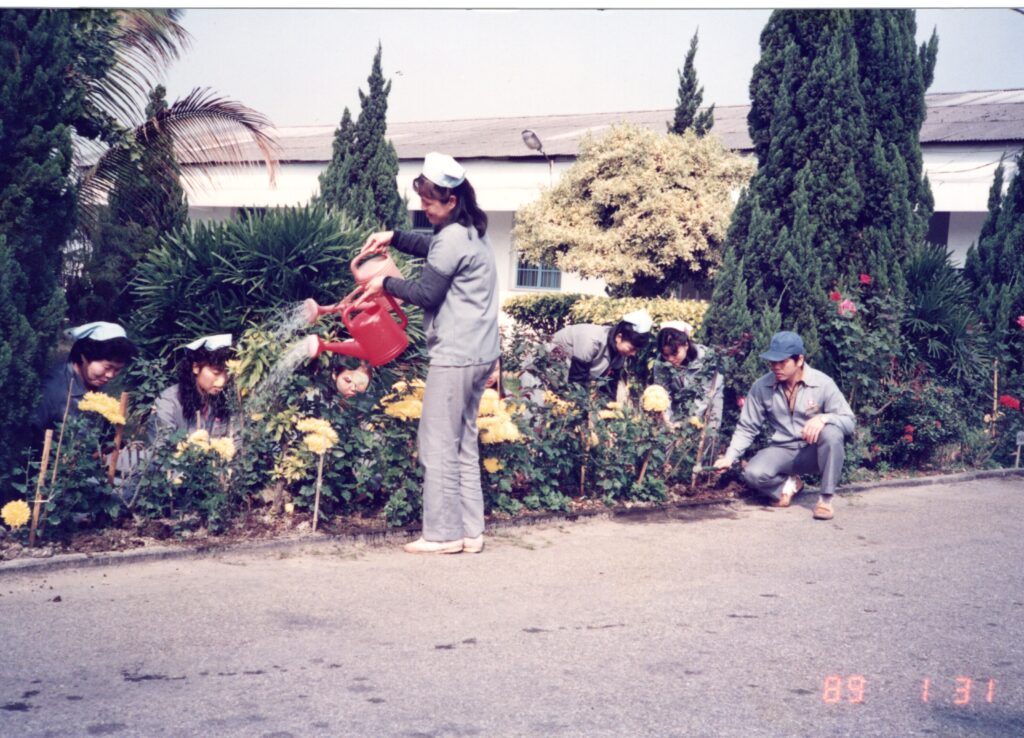
A quality circle activity where employees voluntarily tend the garden during breaks—a tradition still alive today.

The primary goal of developing the new mini movement was to quickly recover the significant past losses.

“So we added a safeguard in our cost estimates.”

For example, if a modification could realistically reduce costs by 10 yen, the report conservatively stated only a 6-yen reduction. This was done to prevent Japan from immediately demanding a lower supply price.

At the same time, Kyooh’s Taipei sales department was informed that the new mini movement was ready for mass production. Although costs had been rationalized, the updated cost sheet was deliberately withheld from the sales department, citing ongoing production adjustments. The sales team was instructed to continue selling at the old mini movement price.

Turning Losses into Profits

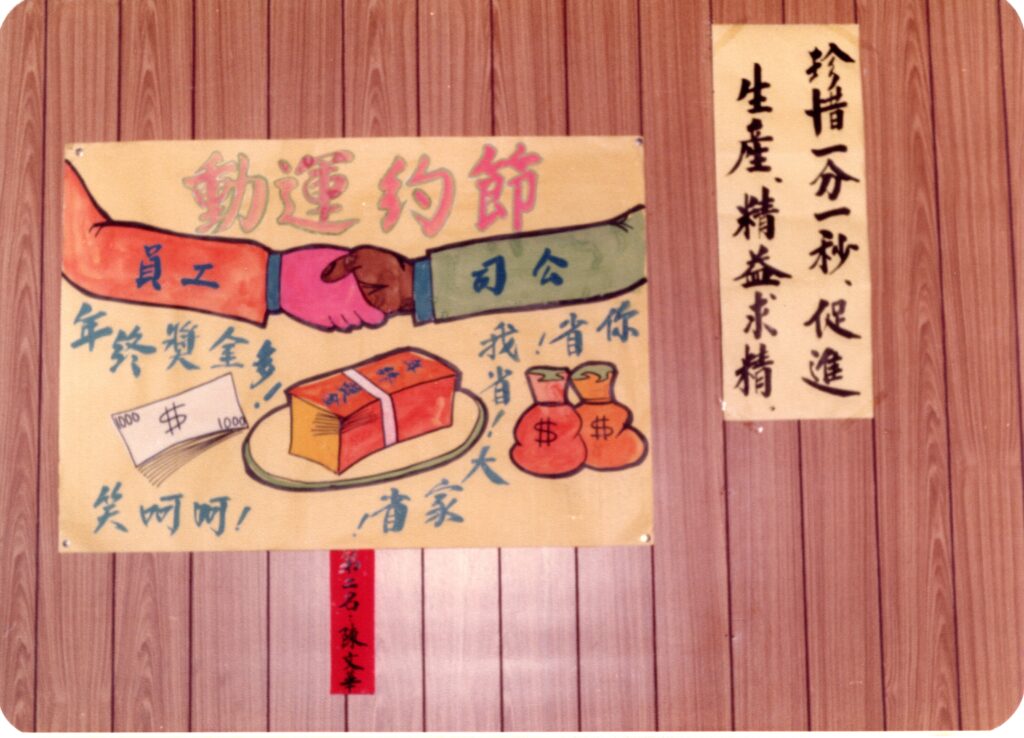
A poster drawn by Kyooh employees for the “Efficiency Campaign,” featuring a handshake between staff and company, with slogans like “You save, I save, we all save,” “More year-end bonuses, more smiles,” and “Cherish every second, boost production, pursue excellence.”
This poster was hand-drawn by Kyooh employees as part of an internal efficiency campaign. At its center is a handshake between staff and company, symbolizing collaboration and shared values. The slogans—“You save, I save, we all save,” “More year-end bonuses, more smiles,” and “Cherish every second, boost production, pursue excellence”—reflect not just management goals but the human warmth and team spirit embedded in Kyooh’s culture.

At the start, the new mini movement was sold at the same price as the original model. With reduced production costs, Kyooh naturally began turning a profit. Sales were kept low-key and steady, with monthly orders reaching nearly 400,000 units. In less than three years, the previous NT$60 million loss was fully recovered.

Japan also understood that Kyooh had incurred losses on this model for three consecutive years. Only after confirming that Kyooh had returned to profitability did Japan begin requesting price reductions.

By this time, due to years of losses, Sankyo had reduced its stake in Kyooh to just 14.9%, returning full management control to the Taiwanese side. The general manager position no longer required Japanese assignments. Following this turnaround, Huang Long-Xi naturally assumed the role of the new general manager.

(Note: For Japanese overseas joint ventures, holding more than 15% would require including the subsidiary’s revenue in Japan’s total accounts. Since Japan had been operating at a loss, reducing its stake to 14.9% prevented Taiwan’s losses from being consolidated into the Japanese parent company’s accounts.)

Deceiving Even One’s Own Team?

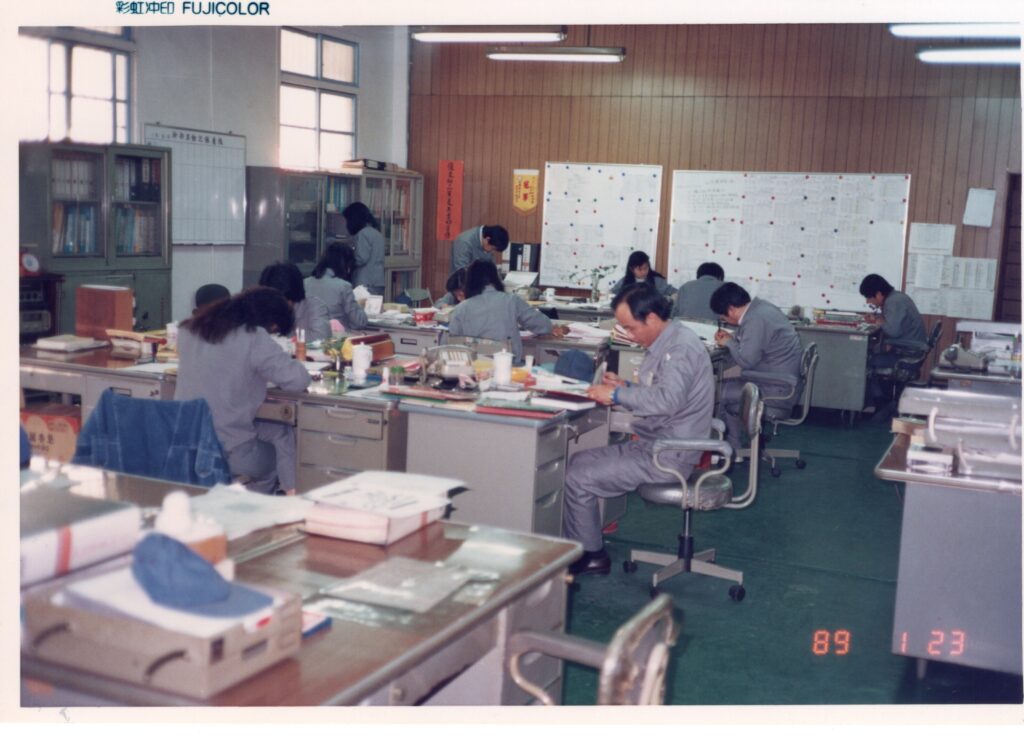
A corner of Kyooh’s office.

After assuming the role of general manager, the mass production of the new mini movement was on track. To ensure transparency in management, he recreated the cost calculation sheet for the new mini movement and sent it to the Taipei sales department.

The sales manager was shocked by the numbers—costs had dropped so much, no wonder there was a profit! Why hadn’t the sales team been informed earlier? After all, knowing the real cost is essential for negotiating with customers.

However, the general manager understood the mindset of salespeople: the cheaper the product, the easier it sells. If the true cost had been revealed, the new mini movement, capable of yielding significant profit per unit, would likely have been sold at a lower price automatically. But that wasn’t necessarily beneficial—the market for mini movements was limited, and lower prices wouldn’t guarantee higher sales volume.

Mini Movements: Taiwan’s First Fully Original Music Box Design

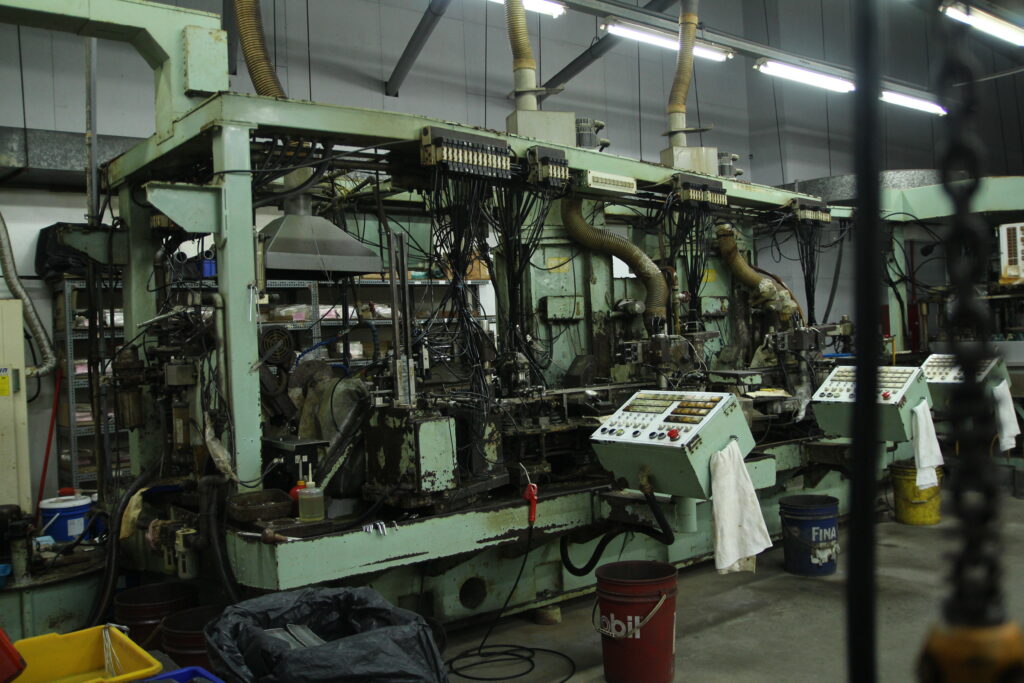
Designed and manufactured by Japan’s Sankyo, this machine cuts vibration plates for mini music box movements.
The background shows an automated workstation used by Kyooh Precision Industry, designed and manufactured by Sankyo in Japan. It slices steel strips and shapes them into comb-like tone plates. Tuning is performed by another Sankyo-built machine, which cannot be shown due to confidentiality agreements. This setup reflects the precision and automation of original Japanese engineering.

The mini movement was, in fact, the first music box movement truly developed by Kyooh itself. After investing around NT$11 million in new component molds and production line modifications, and relocating Japan’s automated vibration plate machinery to Taiwan, all mini movements worldwide began using the version developed by Kyooh, now 100% produced in Taiwan.

“This single product kept Kyooh profitable for ten years.”

Facing Counterfeits

At the time, when the music box industry was still thriving, several factories in mainland China were imitating Kyooh’s mini movements. For example, a music box competitor once ordered 70,000 mini movements from Kyooh. The general manager thought it was a sign that their business was doing well—such a large order.

However, after delivery, they were suddenly informed that the batch had an unusually high defect rate: 1,200 units were deemed defective.

Puzzled by the high defect rate, Kyooh initially had to take the defective units back. Upon inspection, quality control found that only 70 units bore the Sankyo trademark—the rest, over 1,100 units, had the TOYO trademark! The counterfeiters had imitated the mini movements so precisely that they accidentally mixed their own defective fakes into Kyooh’s shipment.

Why the Mini Movement Declined After Ten Years

Although most orders came from Hong Kong, Kyooh’s highly rationalized design made it easy for downstream manufacturers to replicate the music box components themselves. While they continued ordering the basic movements, they secretly began producing the parts on their own.

Soon after, mainland China’s Yunsheng factory figured out how to produce mini movements as well. Because it was profitable, many manufacturers openly copied the design. By then, Kyooh’s patents had expired, leaving no legal way to stop them. Under this wave of fierce competition among numerous manufacturers, sales eventually began to decline.

The Story of Mr. Christmas

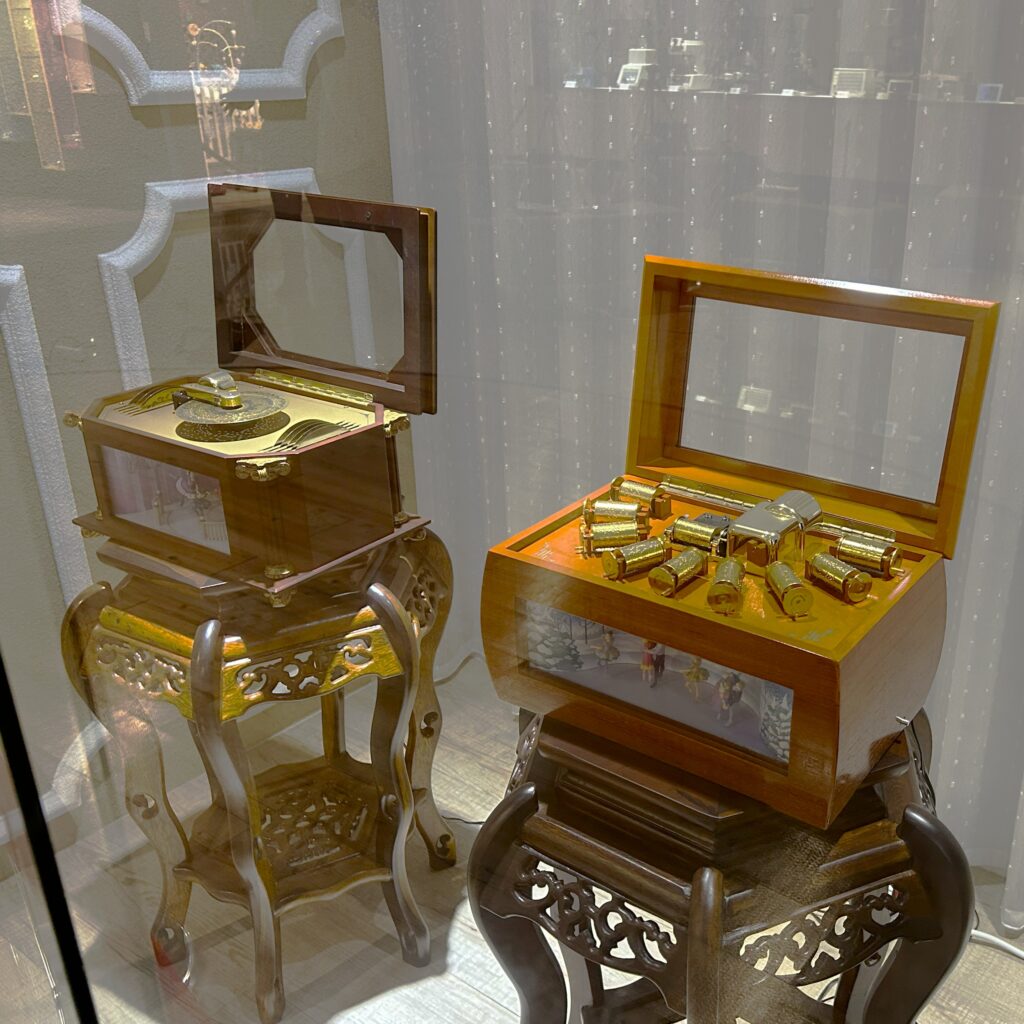
Left: metal disc type. Right: interchangeable cylinder type. Both use Kyooh-made TDM movements.
This image features two distinct Mr. Christmas large wooden music boxes. The one on the left uses a metal disc mechanism, while the one on the right features an interchangeable cylinder system. Both are powered by TDM (Motor Drive Discplayer) movements manufactured by Kyooh Precision in Taiwan or mainland China. These elaborate music boxes were once highly popular for their rich sound and elegant design, but later disappeared from the market. Further details will be discussed in the following sections.

While the mini movement story was unfolding, Kyooh also had another product line: the TDM (MOTOR DRIVE DISCPLAYER), which refers to 20-note motorized music boxes, including disc-type and paper strip music boxes.

For the 20-note TDM models, all components except the steel vibration plates (imported from Japan) were produced and assembled by Kyooh in Taiwan. However, all parts were manufactured strictly according to Sankyo’s design drawings. In other words, TDM was a Japanese-designed model, with Taiwan acting as the contract manufacturer, since Japan no longer produced them.

In terms of sales, TDM essentially had only one buyer: the American brand Mr. Christmas. Orders were placed through Sankyo Hong Kong, and Kyooh received the orders from Hong Kong and handled the actual production.

But TDM orders, which once peaked at 150,000 units per year, eventually plummeted to nearly zero. What happened? Here begins the story of Mr. Christmas and the TDM music box OEM.

Mr. Christmas’ Price-Cutting Strategy

Top two on the right are motor-driven disc-type movements, bottom right is a spring-driven disc-type, and the left one is a hand-cranked paper-strip movement—all part of the TDM series.
This photo showcases music box movements from the TDM series, featuring three playback and drive types: the top two on the right are motor-driven disc-type movements for electric playback; the bottom right is a spring-driven disc-type movement that plays automatically without power; and the left one is a hand-cranked paper-strip movement that plays melodies via manually fed tape. Despite their mechanical differences, all belong to the TDM series and share a unified design classification.

Although Mr. Christmas had massive sales volume, the company was extremely demanding with its suppliers. One of the most notorious practices was requiring suppliers to lower their prices by more than 10% every year. Despite the challenge, suppliers generally complied because the orders were so large.

Faced with such demands, Kyooh had little choice but to move the TDM production line from Taiwan to mainland China to reduce costs while maintaining profitability. However, this annual price-cutting practice wasn’t limited to the music box movements—it applied to wooden boxes, accessories, and all other suppliers as well.

The Fatal Temptation of Orders

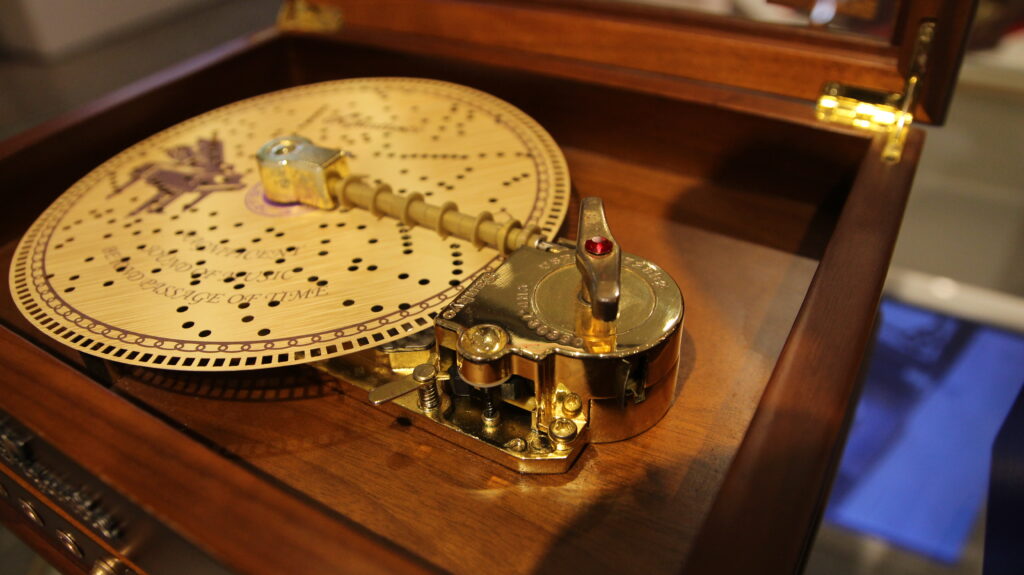
A Taiwanese invention, this paper disc music box improves upon Japan’s plastic disc design with gear-driven square holes.
This image features a paper disc music box developed by Kyooh Precision Industry in Taiwan. The square holes on the disc are an innovation based on Japan’s earlier plastic disc design, which relied on friction and was prone to slippage. By switching to gear-driven square holes, the mechanism achieves greater stability and precision in playback—an example of Taiwan’s ingenuity in mechanical design.

Originally, Mr. Christmas’ wooden box supplier was Hai-Shan, the factory run by the father of the owner of Puli’s “KoKoWu”(敲敲木工房).” They had a factory in Huizhou, China, dedicated to fulfilling Mr. Christmas orders. With such stable demand, the factory grew to nearly 2,000 employees. However, unable to endure the annual price-cutting demands, they eventually refused further orders and withdrew back to Taiwan.

To further reduce costs, Mr. Christmas then outsourced production to a mainland Chinese company called Chuang-Yi. But the same strategy—cutting prices by over 10% annually and delaying payments under various pretexts—led Chuang-Yi to collapse as well.

As a result, Mr. Christmas’ reputation among contract manufacturers was thoroughly damaged. No large wooden box factory was willing to take their orders anymore, causing the company to gradually exit the large music box market.

Thus, the disappearance of Mr. Christmas’ large music box products wasn’t due to declining sales, but the consequences of excessive pursuit of profit. At the same time, Kyooh’s TDM orders also sharply dwindled alongside the disappearance of large-scale wooden box suppliers.

TDM Improvements in Taiwan

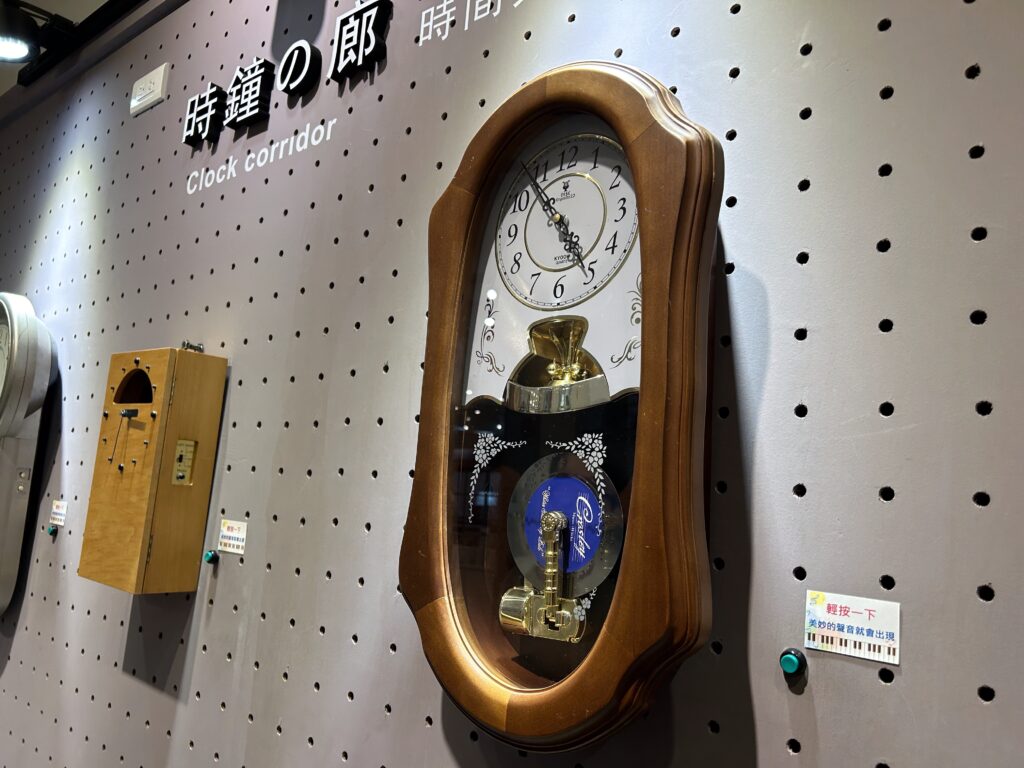
Created to repurpose surplus TDM parts, this clock-style music box struggled in Taiwan due to cultural taboos.
This image features a clock-style disc music box developed by Kyooh Precision Industry as a derivative of the TDM (Motor Drive Discplayer) series. The design emerged in response to surplus TDM components following order cancellations from Mr. Christmas. Despite its elegant form and mechanical ingenuity, the product faced poor sales in Taiwan due to the cultural taboo surrounding the gifting of clocks, which symbolizes parting or death—a regrettable outcome for an otherwise creative solution.

After Mr. Christmas stopped producing music boxes and began canceling orders, Kyooh faced a large backlog of TDM vibration plate inventory. To make use of these TDM components, Kyooh’s developers began creating new products based on the TDM platform.

For example, the paper-disc music box model was developed in Taiwan. Originally, the disc was made of PVC, driven by a rubber wheel. Over time, the disc would slip because the rubber aged and wore down.

The developers realized the rubber wheel wasn’t durable, as it eventually left behind worn powder. So they removed the rubber wheel and added square holes to the disc, switching to a gear-driven mechanism. This optimization was entirely done in Taiwan by Kyooh. Some orders from Japan, such as CITYZEN musical clocks, still use the original rubber-wheel design.


Spring-Driven Disc Music Boxes

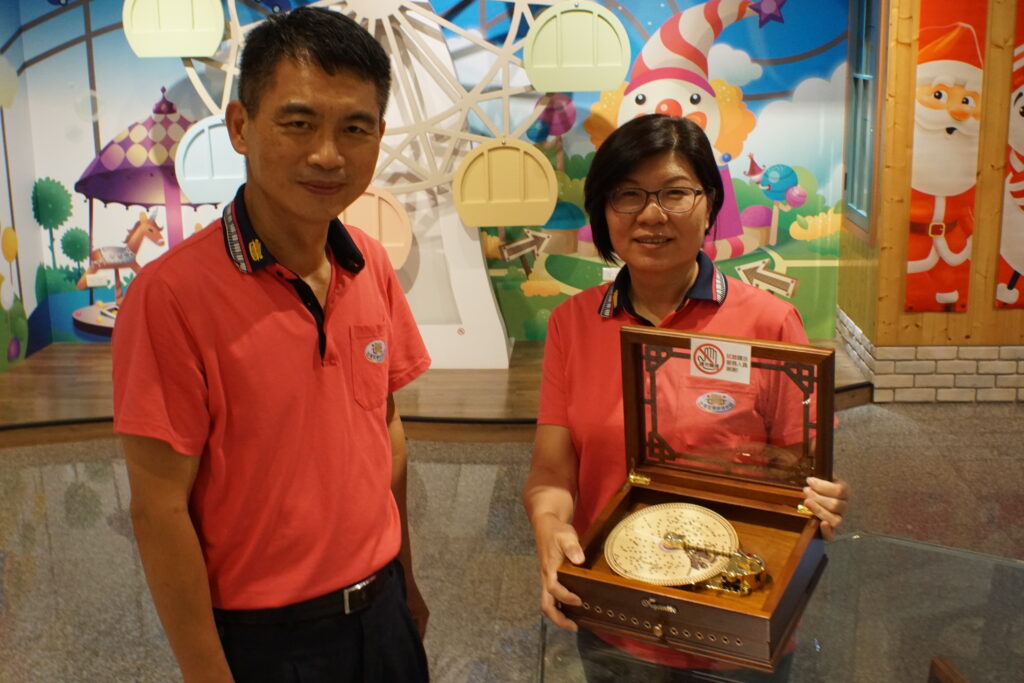
Manager Lin Limei holds a spring-driven disc music box designed by Kyooh—she created the exterior design, while the movement was engineered by Factory Director Chang Chin-Tsai (left).
This photo was taken inside the Kyooh Music Box Museum. Manager Lin Limei holds a spring-driven disc music box designed in-house by Kyooh. She led the exterior design, while Factory Director Chang Chin-Tsai (on her left) developed the movement. This piece reflects Kyooh’s integration of aesthetic design and mechanical engineering, marking a milestone in the brand’s self-developed innovations.

Originally, disc music boxes all used motors. Considering that most people wouldn’t listen to a music box continuously all day, Kyooh developed a spring-driven version. The spring was originally designed for Japanese baby crib music boxes, with a length of 180 cm and a full rotation playing 20 minutes of music. Kyooh adapted it for the disc music box, adjusting it so that a full winding would rotate the disc for six minutes. This model holds patents in the U.S. and China, and was later also sold in Japan.

It’s important to note that although these designs were developed by Kyooh in Taiwan, the products carry the Sankyo brand. This is because Sankyo held shares in Kyooh, and Kyooh had obtained licensing rights to use the Sankyo brand.

“3S”: The Pinnacle of Sankyo’s Ambition

Variants of 3S music box movements: The designs reflect different mounting styles and usage scenarios.

Sankyo invested 45 billion JPY to build a fully automated factory for the 3S model in Hara Village, Suwa District, Nagano Prefecture, Japan. Simply put, trucks would deliver metal blocks and plastic pellets, and what came out were complete music box movements.

The factory was enormous, featuring three fully automated production lines. This represented the peak of Sankyo’s ambition in music box manufacturing, but it also marked a turning point toward the decline of Japan’s music box industry.

The 3S Fully Automated Production Line: A Misguided Decision

Music boxes are automatically wound on the track. Operators use auditory judgment to determine quality before placing them into trays. Semi-automation began in the 2S era.
This photo documents the final sound quality inspection process for music boxes. After automatic winding on the track, operators alternate hands to lift each unit to their ear, judging whether it meets shipping standards before placing it into trays. Since the 2S era, production has been semi-automated. Sankyo’s ambition was to replace manual labor with full automation, pushing cost reduction to the extreme—reflecting Japan’s efficiency-driven manufacturing ethos.

When Japan moved the 2S model production to Taiwan, it was already operating on a semi-automated production line. If they had simply continued producing 2S or 3S on a semi-automated line in China instead of investing in a fully automated 3S line, companies like Yunsheng might never have emerged.

At the time, the monthly wage in China was only 100 RMB. The 45 billion JPY investment in automation could have paid thousands of workers annually through depreciation alone, making a fully automated line unnecessary.

A few years after the 3S fully automated factory was completed, Yunsheng had already set up in China. When personnel from Kyooh visited Yunsheng, they were shocked to see hundreds of workers hand-tuning vibration plates simultaneously, showcasing the power of labor-intensive methods over costly automation.

Labor Was Actually Cheaper Than Machines

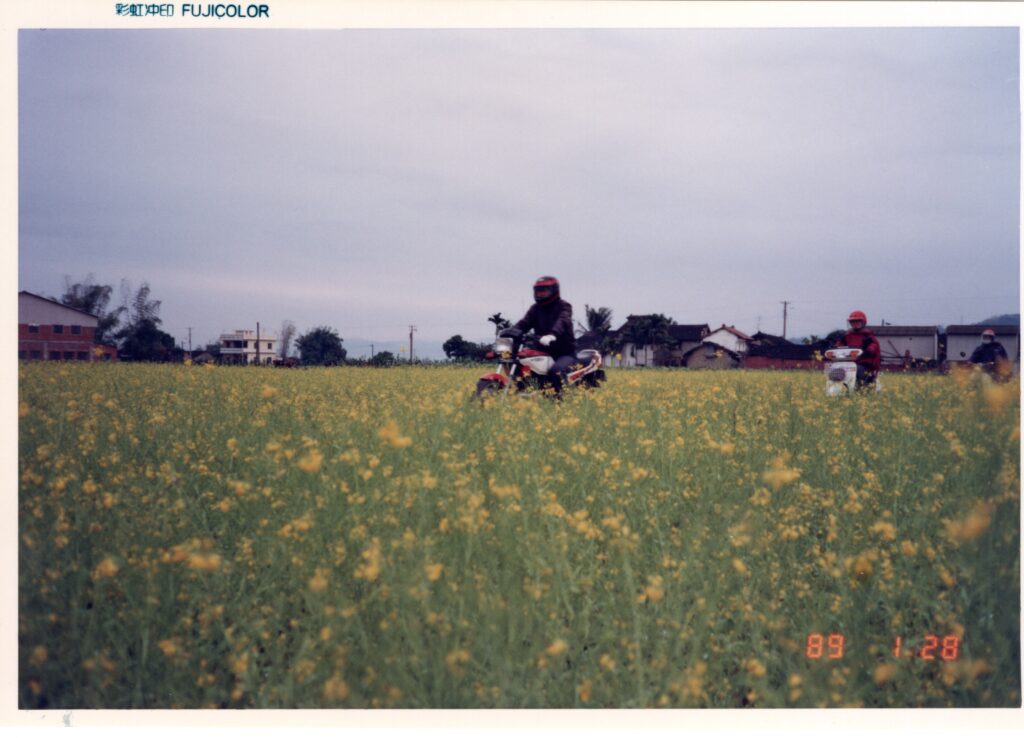
Riding through rapeseed fields in Wufeng
This photo captures a nostalgic ride through the rapeseed-lined paths of Wufeng. Despite nearly four decades passing, the landscape remains pristine and beautiful. The scooter seen in the image is suspected to be a Kymco HS135—if you can confirm the model, we’d love to hear from you.

In the end, the fully automated 3S production line in Japan cost more than producing the same units in China using labor-intensive methods. High expenses for equipment depreciation and maintenance made the automated line less competitive in price. As a result, orders dropped, and the automation could never run at full capacity. Japan was left with no choice but to adjust in response to Chinese competition.

Sankyo Asked Kyooh to Set Up a Factory in China—but Failed

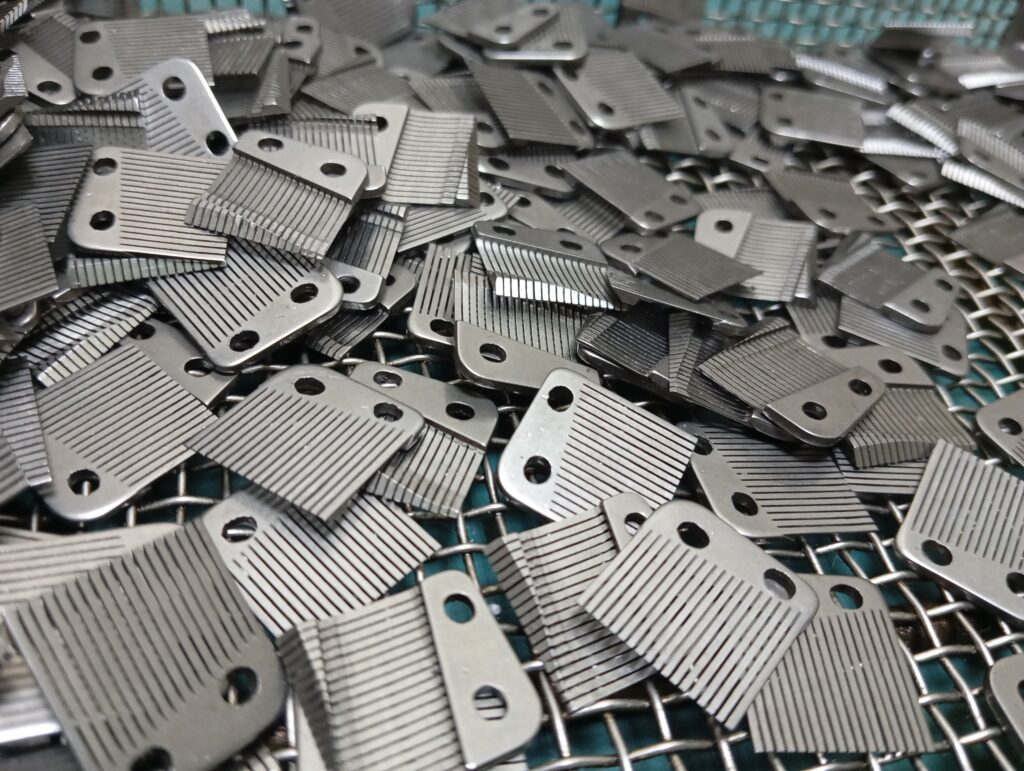
Stacks of mini movement tone plates awaiting tuning
This image shows stacks of mini music box tone plates awaiting tuning. Each comb tooth must be individually adjusted to a precise pitch. Japan’s Sankyo once aimed to automate this process to reduce labor costs, but the reality proved otherwise—developing and maintaining such machines was more expensive than manual tuning. This raises a broader question: is automation always the right path? In crafts like music box making, where precision and cost-efficiency must coexist, human skill remains indispensable.

After Sankyo’s 3S automated production was undercut by Yunsheng’s low-cost manual strategy, production collapsed. Even Sankyo’s own Guangzhou plant abandoned music box manufacturing. Sankyo tried suing Yunsheng in a Henan court for patent infringement, but since Yunsheng functioned almost like a state-owned enterprise, the lawsuit predictably failed.

Desperate to compete on price and continue serving long-time Sankyo music box customers, Sankyo asked Kyooh to set up a large-scale 3S production base in China with 2,000 workers, targeting 30 million units per year.

Kyooh, however, assessed that by then Yunsheng was already well-established and that the Chinese market was flooded with unbranded knockoffs. Seeing no first-mover advantage, Kyooh declined the request to build a 3S factory in China.

Sankyo’s China Factory Run by Nanji

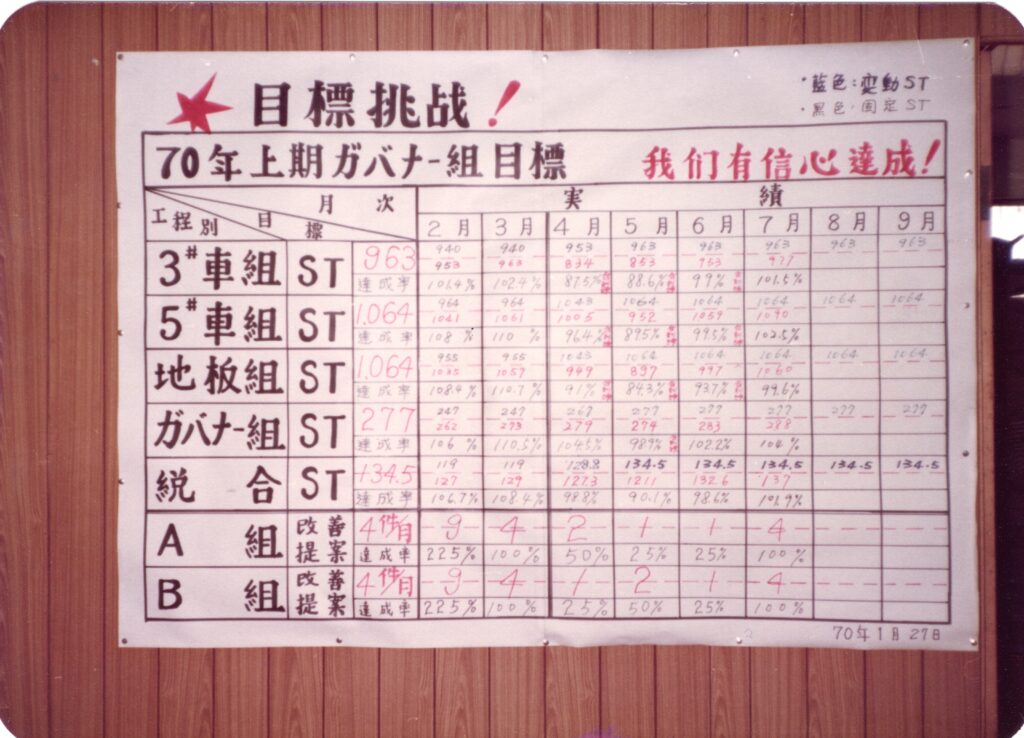
Each team set its own monthly goal and tracked actual output for comparison. The general manager emphasized honor-based motivation, rewarding achievements with certificates rather than bonuses.
Taken in 1981 (ROC Year 70), this photo documents the monthly production goals and actual output of each team at the Kyooh factory. Teams set their own targets and compared results. The general manager noted that motivation was driven by a sense of honor, with certificates awarded to encourage improvement rather than monetary incentives.

With Kyooh declining to set up a factory in China, Sankyo turned to Nanji, Taiwan’s largest music box distributor at that time. Since Sankyo was planning to halt 3S production in Japan and Kyooh had no interest in a China facility, Nanji—whose core business was selling music boxes—faced the risk of losing its main product line. Reluctantly, Nanji agreed to establish a factory in China.

Kyooh even assisted Nanji by setting up the first 3S production line in China and training the initial batch of employees. With Sankyo’s Guangzhou plant already shut down, Nanji became Sankyo’s sole manufacturer and distributor in China, reaching an annual output of 20 million units.

Kyooh’s Decision to Set Up a Factory in Dongguan, China – Reason 1

During a technical visit, Muro Box founder, Chen-Hsiang Feng, meets Kyooh VP, Lin Chih-Cheng, in Dongguan.
This photo captures Muro Box founder, Chen-Hsiang Feng, with Kyooh Precision Industry Vice President, Lin Chih-Cheng, at Kyooh’s Dongguan facility. Since Muro Box shares vibration plate specifications with the TDM model, the team faced early development challenges and visited Kyooh for technical insights. The visit was warmly received by VP Lin, and this photo commemorates a meaningful moment of cross-brand collaboration.

After Deng Xiaoping’s reform and opening-up, many foreign companies started investing and producing in China. At that time, Kyooh worked with around 100 suppliers, all handling very large orders. Unexpectedly, over 90 of them moved their operations to China.

Initially, most Taiwanese businesses settled near Guangdong, so Kyooh didn’t feel the need to follow—shipping from Taiwan to China seemed sufficient. Even when Sankyo requested Kyooh to produce 3S models in China, Kyooh remained unmoved.

However, as Taiwanese businesses spread to Tianjin, Beijing, and even Sichuan, customers began complaining that shipments from Taiwan took too long. Combined with tariffs and a 30%+ VAT, profits were heavily eroded. With the entire upstream and downstream supply chain relocating to China, Kyooh had no choice but to establish a factory in Dongguan, directly serving Taiwanese businesses and expanding its operations on-site.


Kyooh’s Decision to Set Up a Factory in Dongguan, China – Reason 2

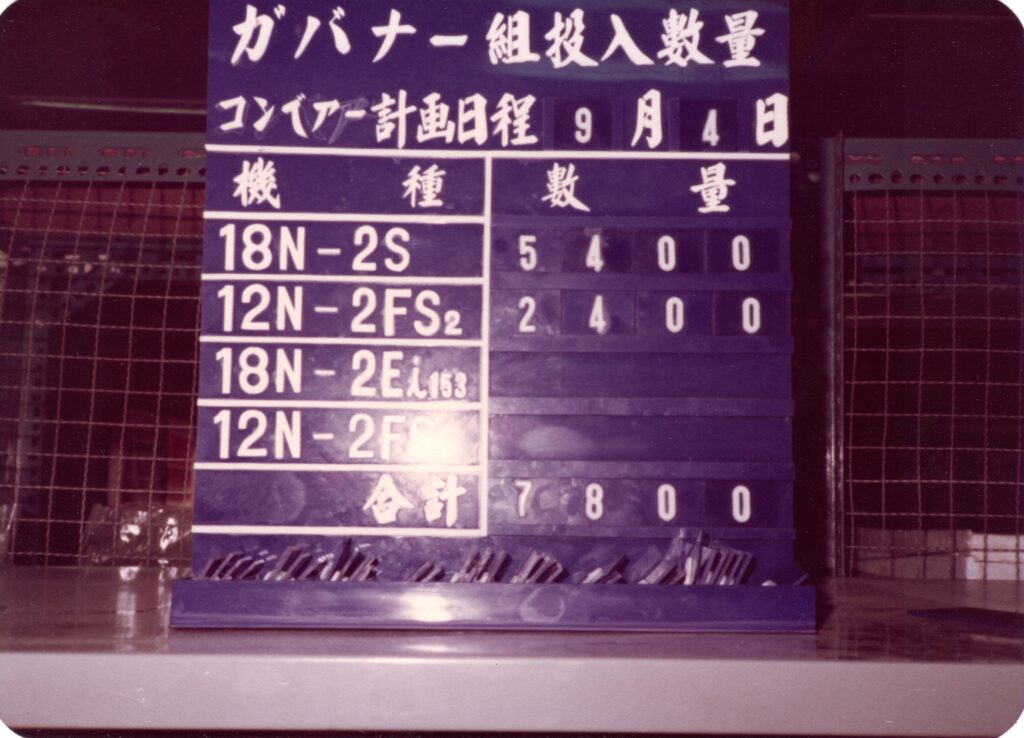
The 18N-2S is a standard 18-note movement, while the 12N-2FS features a protruding shaft for winding or rotating accessories—evidence of 12-note designs before the 3S model.
This record board comes from the early Kyooh factory line, documenting planned input quantities for various music box movements. The 18N-2S is a standard 18-note 2S movement, while the 12N-2FS features a shaft protruding from the top of the spring case, allowing winding from above or accessory rotation. This design confirms that 12-note variants existed prior to the release of the 3S model. After the 3S was introduced, these earlier versions were discontinued.

After Sankyo’s Guangzhou factory, which produced 3S and 2.5S models, shut down, the Chinese company Nanjie took over the lower-cost, high-volume 3S production but abandoned the 2.5S model. The 2.5S retained the metal look of the 2S, could be plated gold or silver, and was ideal for music boxes where the mechanism is visible. However, its higher production cost and smaller quantity made it less attractive.

At that time, Kyooh’s sixth general manager, Maruyama, who had been the last GM of Sankyo’s Guangzhou factory, thought it was a pity that Nanjie abandoned 2.5S, since the Guangzhou factory still had an annual market demand of 2.5 million units. Despite the higher cost, the added value justified production. He proposed that Kyooh set up a factory in China to take over 2.5S production.

At the same time, labor-intensive TDM models could also be shifted to the Chinese factory, taking advantage of low wages to optimize costs and generate profits.

Consequently, in January 2002, Kyooh officially began music-spring production in Qishi Town, Dongguan, Guangdong Province.
Japan’s Cost-Reduction Measures for the “3S” Model

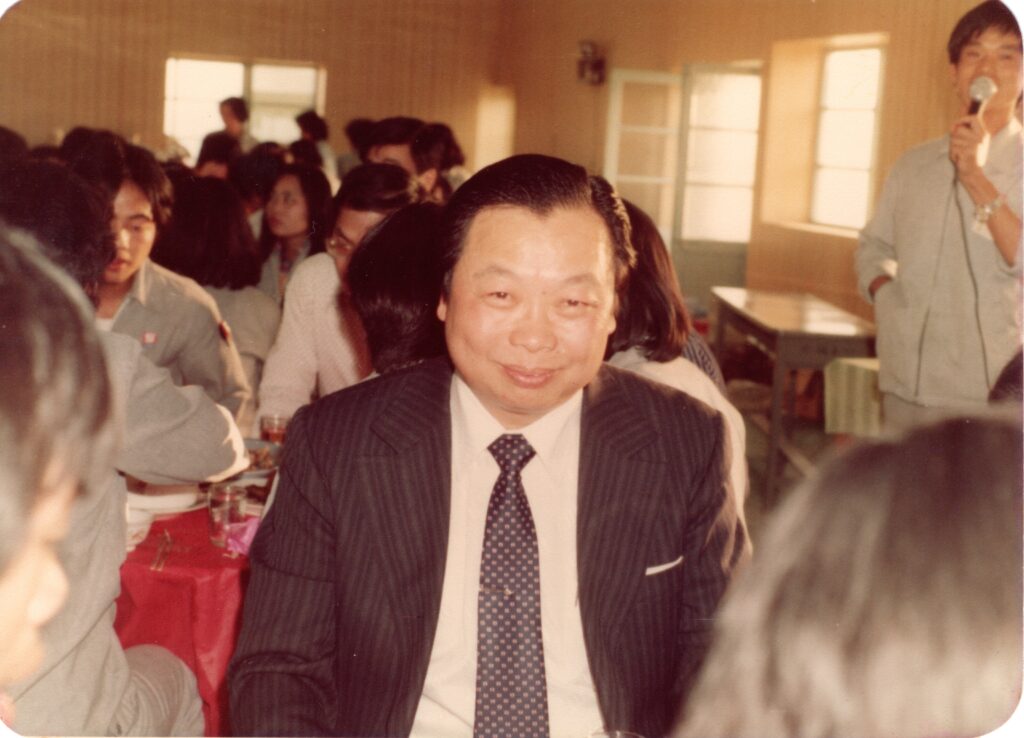
The Quality Month Meeting (Presenting Results): Holding the microphone is Kyooh’s second general manager Okubo Manabu, center is General Affairs Chief Wu Shuang-Ying, and standing on the podium is Manufacturing Manager Huang Long-Xi.
This photo was taken on December 5, 1981, during Kyooh’s Quality Month Meeting. In its early years, Kyooh held monthly themed campaigns—such as November’s Quality Month, where each department proposed ways to improve production quality and presented their results after one month of implementation. Holding the microphone is second general manager Okubo Manabu; in the center is General Affairs Chief Wu Shuang-Ying, whose department played a key role in preserving Kyooh’s historical photos. On the podium stands then-Manufacturing Manager Huang Long-Xi.

To lower costs, Japan commissioned Kyooh to rationalize the 3S base, reducing its weight from 40 g to 36 g. The production of the base was shifted to suppliers in Taiwan and China, and other components—such as gears and plastic spring covers—were also sourced from the two regions.

At Kyooh’s China factory, these parts were pre-assembled into a semi-finished state (without the vibration plate and cylinder) and then sent to Japan for final assembly. The cylinder and vibration plate production and tuning still used parts of the original fully automated Japanese production line.
Previously, the spring covers were stamped with “Sankyo Japan”, but since they were now produced in China, regulations prohibited marking them as “Japan.” Consequently, the covers were labeled simply “Sankyo”, while the Japanese origin was indicated on the newly designed packaging produced in Japan.
Japan’s Failed “4S” Model

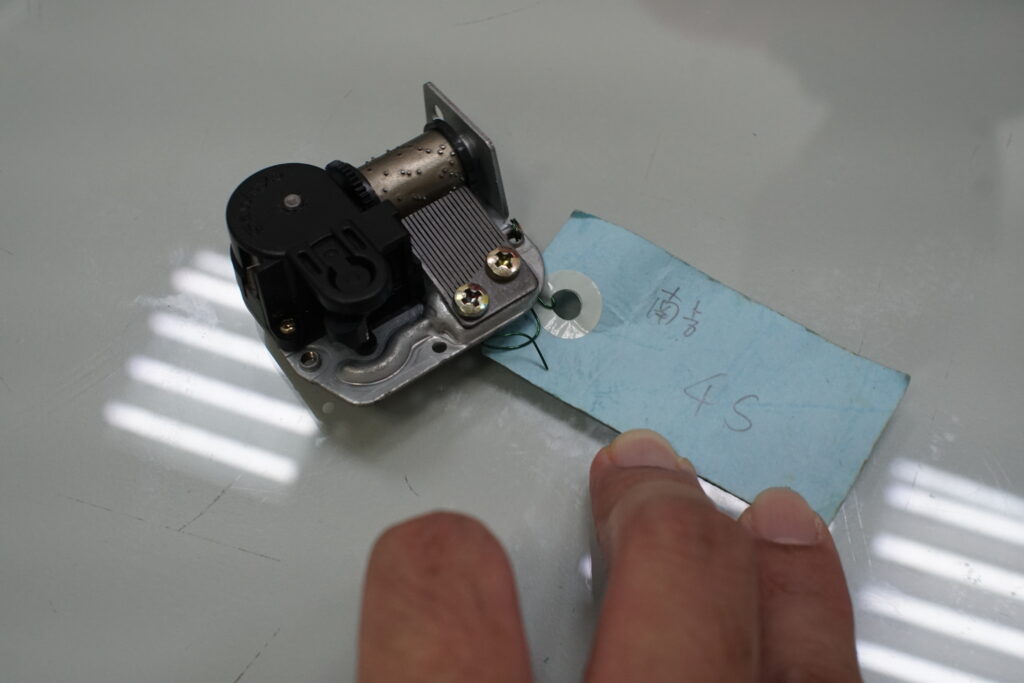
Sankyo’s cost-reduction 4S music box movement, built with an iron base and lacking visual refinement, failed to appeal to consumers. This model was produced at Nice Sankyo’s mainland factory through technology transfer. The sample is damaged and cannot be played.
This is Sankyo’s experimental 4S music box movement, developed to reduce costs amid rising zinc alloy prices. Sankyo replaced the zinc base with a cheaper iron plate, but due to stamping limitations, the vibration plate was assembled at an angle, resulting in a less refined appearance that failed to attract consumers. The “南吉” label indicates this model was produced at Nice Sankyo’s mainland factory through technology transfer. Unfortunately, the sample is damaged and cannot be played.

In addition to the fully automated 3S model, Japan also developed a fourth-generation 4S model. The motivation was cost reduction: the price of zinc alloy for the base had risen significantly, so they switched to stamped iron sheets for production.

However, customers did not accept it. Because the 4S base was made from stamped iron, the limited height forced the vibration plate to be installed at an angle. This compromised the overall aesthetics, making the product feel less premium and less appealing to consumers.

The failure of the 4S was therefore not due to sound quality, but because the appearance was unattractive to customers.

Taiwan’s Kyooh “5S” Model Development

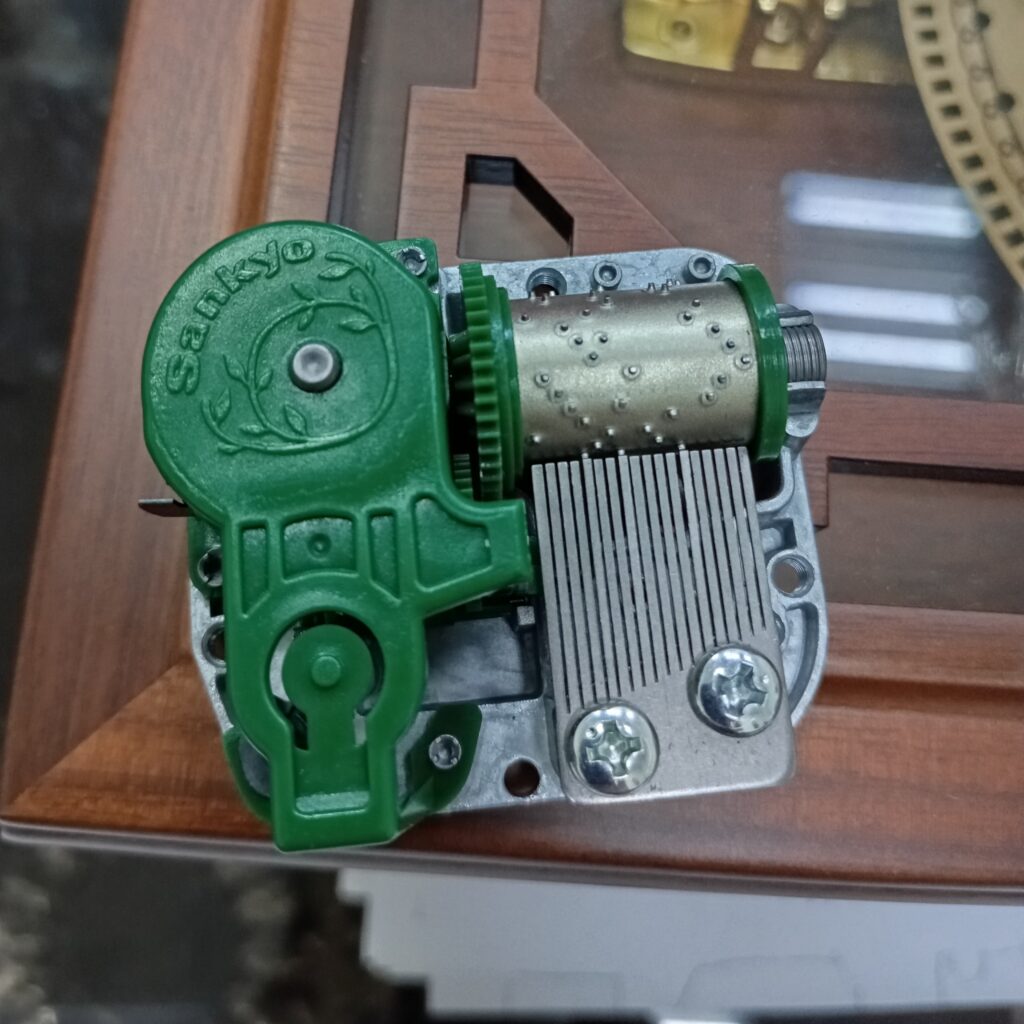
The green 5S movement reinforces the governor by anchoring it to both the cover and zinc-alloy base.
This image shows the 5S music box movement developed by Kyooh Precision Industry. To distinguish it from Japan’s black 3S model, Kyooh adopted a green casing. Beyond reducing weight and cost, the key innovation lies in extending the governor support and anchoring it to both the mainspring cover and the zinc-alloy base. This structural enhancement resolved a long-standing issue with the 3S model, where the governor was prone to damage during shipping—dramatically improving durability and reducing defect rates.

Amid the intense price competition between China’s Nanji “3S” and Kyooh’s own “2.5S”, and with the approval of joint venture Japan Sankyo, Kyooh in Taiwan independently developed the “5S” model, deliberately changing the case color to green to visually distinguish it from the black “3S” model.

The 5S addressed all the shortcomings of the 3S. For example:
The green mainspring cover was reinforced to protect the stop lever, preventing damage.
The base weight was reduced from 41g to 30g, significantly lowering costs without compromising quality.

After development, Kyooh sent ten 5S samples to Japan for blind comparison against the 3S. The result: all Japanese engineers could not distinguish any quality difference, proving the design was a success. Despite weighing only 30g (compared to 41g for 3S), the 5S maintained the same performance, achieving both cost reduction and quality retention—a significant technical accomplishment.

The 5S model also received development subsidies from Taiwan’s Ministry of Economic Affairs Industrial Development Bureau under the 2009 Traditional Industry Technology Development Program, and Kyooh applied for patents to protect against aggressive competition from China’s Nanji and other no-brand manufacturers.

The successful mass production of the 5S became the mainstay model for Kyooh’s 18N music box movements.

“5S” Even Surprised Japan

Kyooh’s manual inspection of early-design 3S movements. Due to stop lever deformation, around 300,000 units were recalled for rechecking.
This photo captures the manual inspection scene at Kyooh. The early design of the 3S music box movements, produced via full automation in Japan, suffered stop lever deformation during transport, leading to widespread complaints. As the Taiwanese factory invested by Sankyo, Kyooh took responsibility by recalling around 300,000 units and inspecting them one by one. This image documents that quality recovery effort.

Eventually, the head of Sankyo Japan’s sales department personally asked Kyooh Taiwan how they managed to achieve it—what was the key breakthrough in the design?

General Manager Huang replied:

“Do you think I would explain the breakthrough in detail?”
“I said I cannot describe the exact key points, but we accomplished it through our effort.”

The floral patterns on the green mainspring cover were also a result of Japan–Taiwan collaboration. After seeing the samples, the Japanese suggested that engraved patterns would look better and provided drawings for Kyooh to implement.

Although Japan Sankyo did purchase some 5S units, their domestic sales still primarily focused on the 3S model—designed by Japan, and produced using the semi-assembled components from Taiwan or China, with final comb and cylinder assembly completed at the factory in Nagano Prefecture’s Suwa District.


Relationship Between Kyooh Taiwan and Dongguan Factories

Located in Kyooh’s Taiwan factory, this vibration plate tuning machine has been in service for over 30 years.
This photo was taken at Kyooh’s Taiwan factory, showcasing the automatic tuning machine for music box vibration plates. With over 30 years of history, this workstation has tuned every vibration plate used in Kyooh’s mini movements.

The Kyooh Taiwan factory and the Dongguan (China) factory operate under a division-of-labor system. The Taiwan factory took over the automated production line for Japan’s mini music movements and is mainly responsible for producing the vibration plates, including stamping, cutting, grinding, and tuning. The factory has two fully automated lines. The music cylinders for mini movements are also produced in Taiwan and then supplied to Dongguan for assembly. In short, the Taiwan factory produces the key components, while the Dongguan factory handles assembly.

Although Japan requested that part of the mini movement’s automated production line be moved to Dongguan, the current system represents a cross-strait collaborative workflow. Overseas orders are shipped from Dongguan, while orders for Taiwan remain produced locally in Wufeng, albeit in smaller quantities.

Were there other music movement factories in Taiwan?

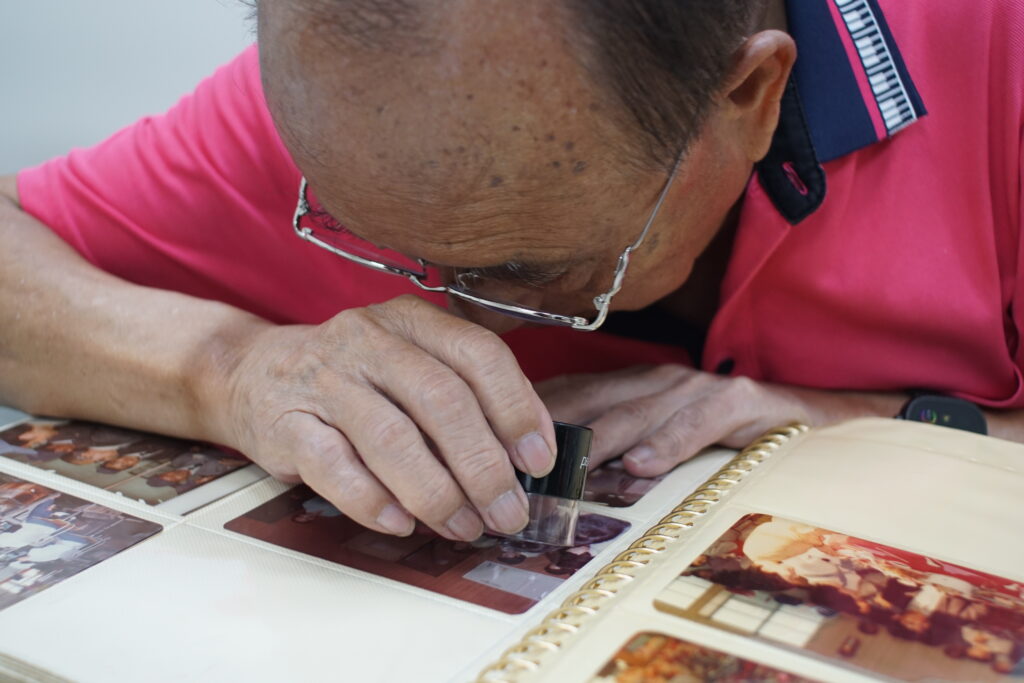
General Manager Huang Lung-Hsi carefully examines the details of a historical photo using a magnifying glass at the Kyooh Music Box Museum.

When Mr. Huang served as a director of the Taiwan Toy Association, he had heard that because the demand for music movements in toys was so large, the association had once considered commissioning the Industrial Technology Research Institute to develop and produce music movements. However, it is unclear whether the project failed or was never actually carried out, and in the end, nothing came of it.

Therefore, prior to the emergence of Kyooh, Taiwan did not have any factories that produced music movements. After Kyooh appeared, the general manager was notified twice by suppliers that competitors were attempting to create molds to imitate music movements, but none of these attempts ever reached the market. In other words, although some Taiwanese factories had ambitions to produce music movements themselves, they never truly succeeded.

The only concrete information known is regarding Japan’s Toyo music movements. It was heard that Toyo planned to cooperate with a Taiwanese music movement distributor, Gao Mei Company, to establish a factory called Hua Mei in Beitou, Taipei, to produce Toyo-branded music movements. From the general manager’s perspective, however, he had never seen any actual products being produced. It is only known that Hua Mei later moved to Tianjin, China—the same factory that previously imitated mini music movements—and continued producing Toyo music movements. Hua Mei has since ceased operations and, according to reports, was sold to local Chinese owners under a new name.

Letting More Taiwanese Know the History of Music Movements

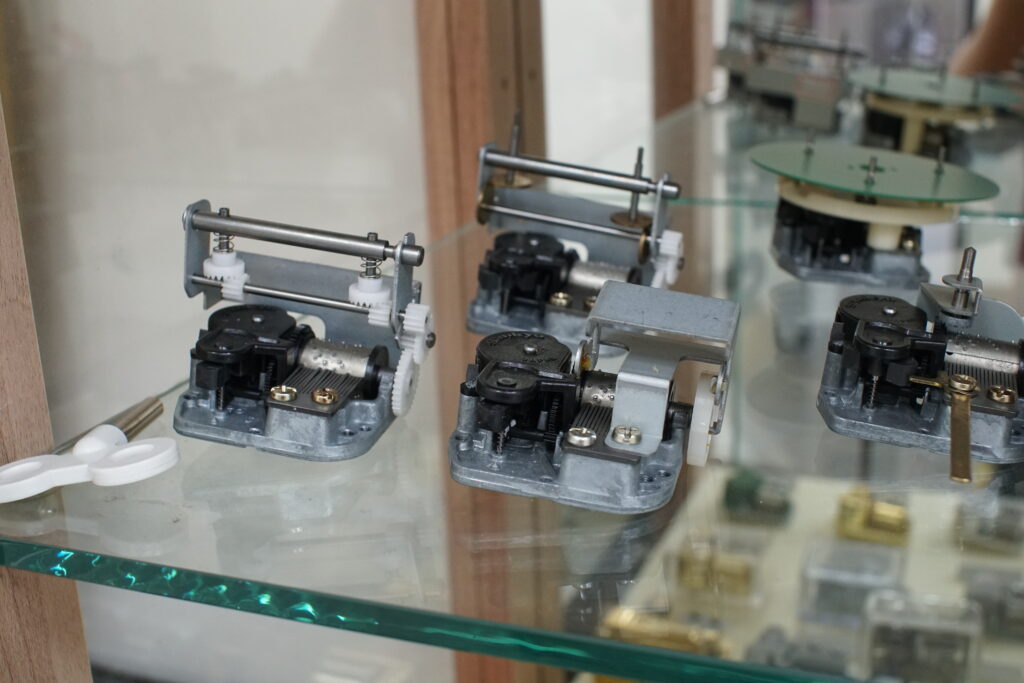
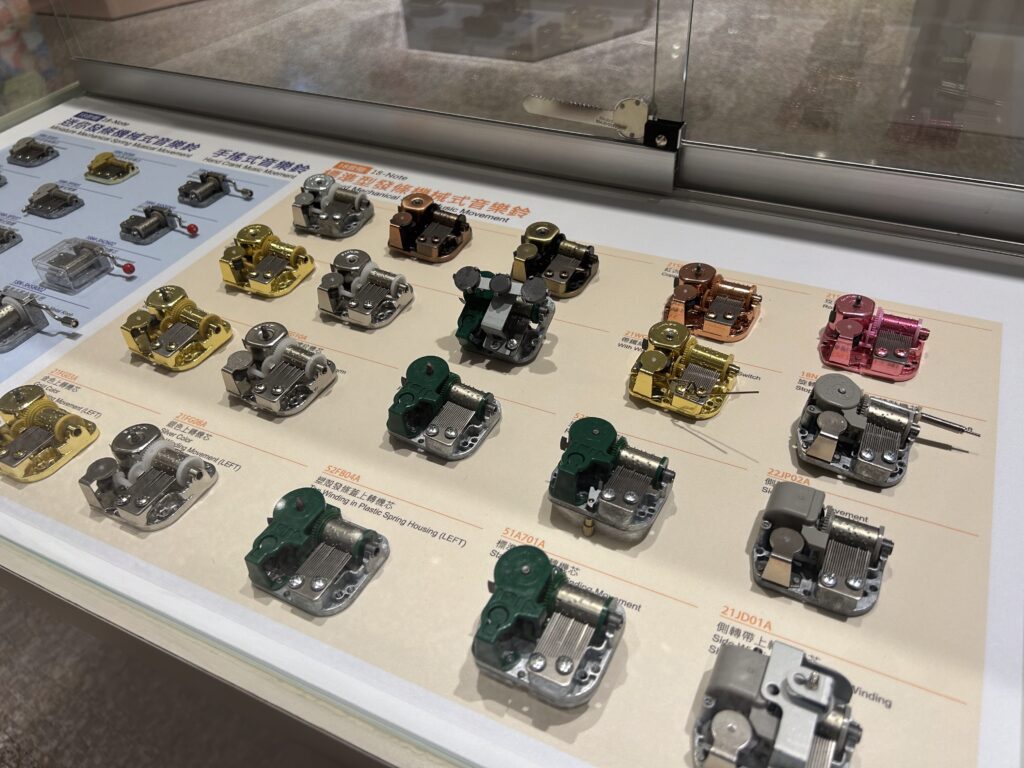
Hand-cranked and spring-driven mechanisms with diverse rotation styles inspire creative music box designs.
This image showcases a variety of music box movements, including hand-cranked and spring-driven types. The rotation mechanisms vary—center-driven, side-driven, top-driven, and even touch-sensitive stoppers. These unique engineering features allow for a wide range of imaginative music box exterior designs.

In Taiwan, Kyooh is the only factory producing music movements, and it has been operating for more than forty years. Very few people actually know how many music movements have been supplied to music box distributors in Taiwan and exported around the world. Most Taiwanese don’t even know what a “music movement” is—they only know the music box. And when it comes to music boxes, their understanding is usually limited to just two types: dancing dolls and jewelry boxes.

Even when the Wufeng Cultural Association was being established, the Lin Family Garden was leading the initiative. At that time, the executive director of Lin Family Garden went to Kyooh to see Mr. Huang, the general manager:

“I heard we have music movements being produced in Wufeng?”
“Yes, it’s been over forty years.”
“How come I never knew about this?”

Kyooh Had Very Little Direct Contact with Consumers

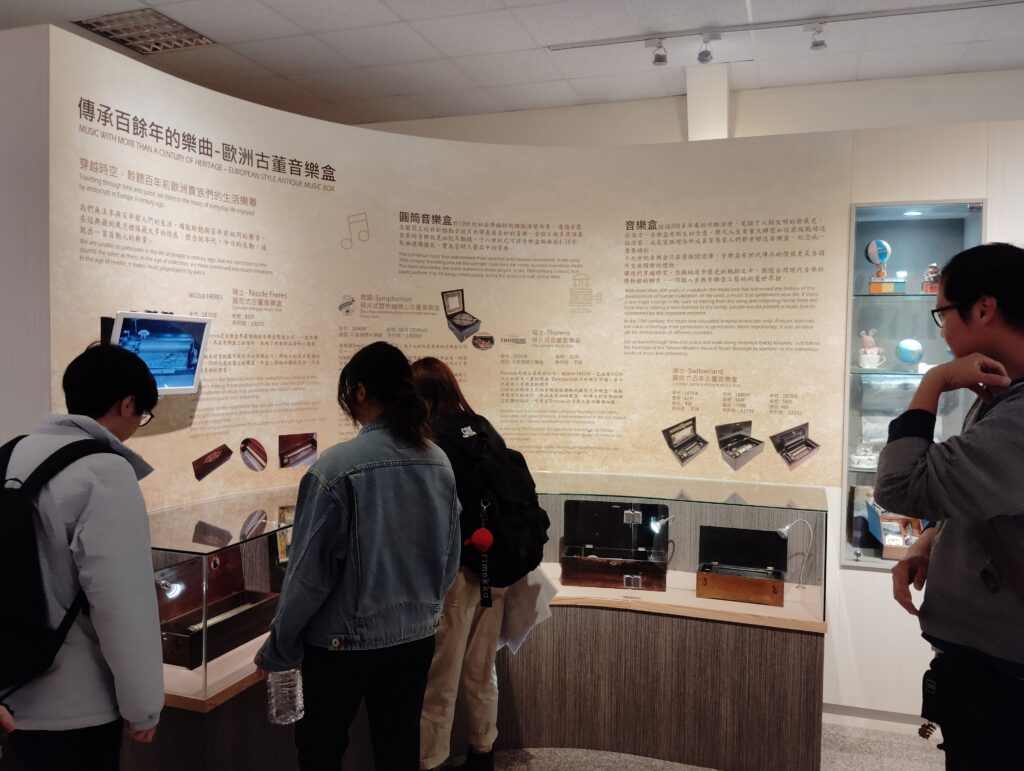
Each music box in the European collection holds a story waiting to be discovered.
This image shows the European music box collection at the Taiwan Modern Music Box Museum in Taichung. Every piece is more than a mechanical marvel—it carries history, emotion, and craftsmanship. Taiwan was once the world’s largest producer of music boxes, and the museum’s collection reflects that legacy. When you visit, take time to ask the staff about the stories behind each box—they’re worth uncovering.

Kyooh’s customers were all businesses—they bought the music movements, installed them in boxes, and sold them as finished music boxes. There weren’t many customers, only about a hundred or so, all of them music box manufacturers. Naturally, anyone who needed to buy a music movement would come directly to Kyooh. There was no need for advertising, which is why most people didn’t know about them.

In fact, very few people realize that music movements come in a variety of scales: 18-note, 12-note (this was an option in the 2S era; after the 3S model was introduced, production standardized to 18-note, so 12-note was discontinued), 20-note, 22-note, 23-note, 50-note, 70-note, and even over 100 notes. But who knows that? Most people don’t.

“It’s necessary to let everyone know that music boxes come in all these varieties—not just dancing dolls and jewelry boxes.”

The Process of Establishing the Modern Music Movement Museum

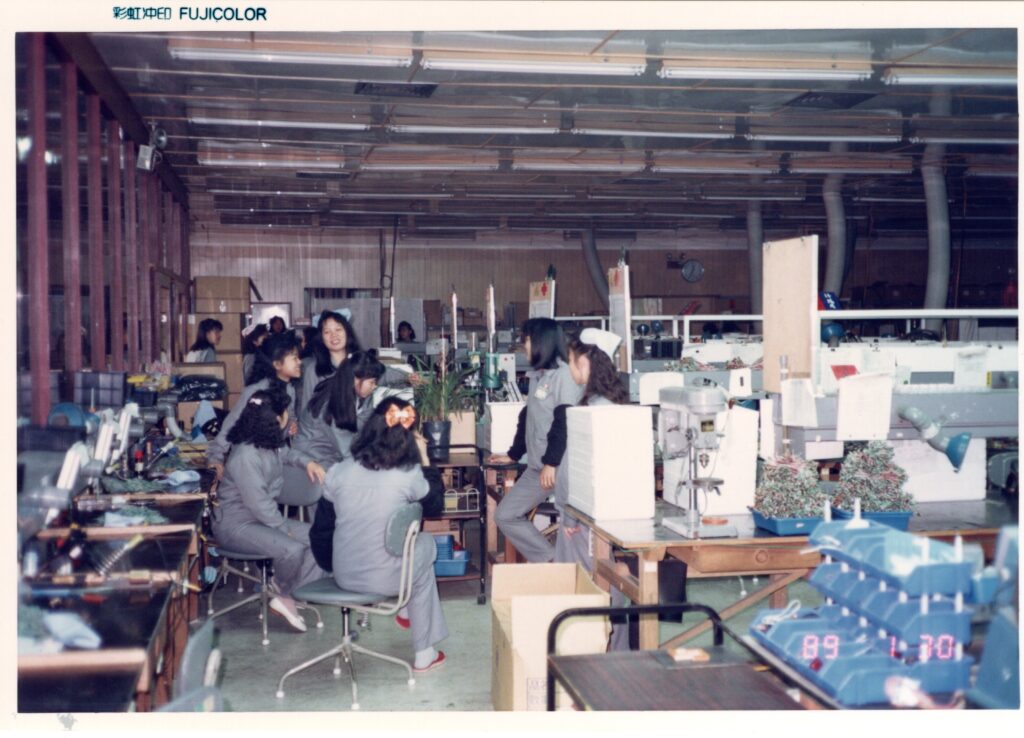
Ladies wearing the production team’s uniform chatting during break at Kyooh’s electronic production line. This factory was later renovated into the Modern Music Box Museum.
This photo was taken at Kyooh’s electronic music box production line, showing ladies wearing the production team’s uniform chatting during their break. In addition to mechanical music boxes, Kyooh once produced electronic items like musical greeting cards and Touch Me dolls. Unable to compete with low-cost Chinese manufacturing, the factory was eventually shut down. Years later, it was renovated into the Modern Music Box Museum, preserving the legacy of Taiwan’s music box industry.

The building chosen for the museum was originally a factory for electronic music movements. After the production lines were removed, the space became vacant.

Between 2015 and 2017, this period coincided with a wave of retirements among Kyooh’s senior employees. To address the retirement fund obligations (under the old Labor Standards Act, companies were required to fully set aside retirement reserves in a lump sum), Kyooh sold part of its land.

With a significant reduction in personnel and empty factory space, electronic production had ceased, and the number of mini music movements had also declined considerably. At this point, the question of whether Kyooh still had value in Taiwan was put squarely on the table.

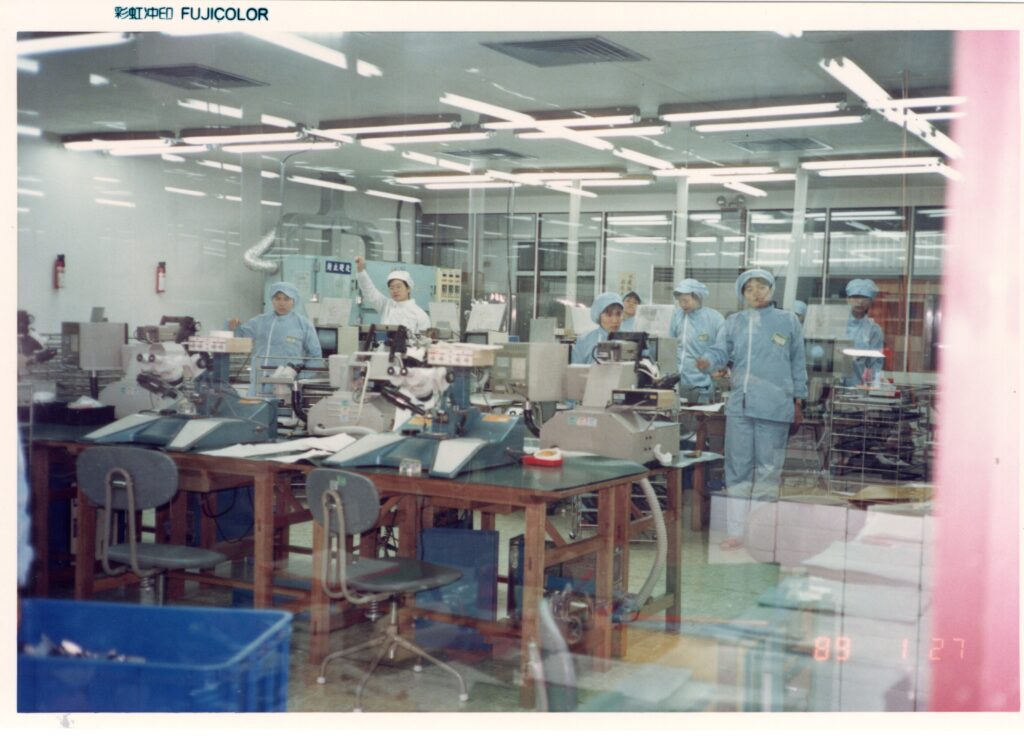
Kyooh’s cleanroom for wire bonding bare-die ICs. A music box brand with semiconductor-grade facilities—unexpected but true.
This photo shows the cleanroom in Kyooh’s early electronic production line. To reduce costs in mass-producing electronic toys, bare-die ICs were used and required wire bonding in a dust-free environment to connect chips to circuit boards. It’s surprising to many that a music box brand once operated facilities meeting semiconductor-grade standards.

Back in 2010, the general manager had already started thinking about setting up a museum. But how could all the documents and the various types of music box samples be collected? In the past, the customers who bought music movements from Kyooh would assemble them into music boxes and keep a few samples on display shelves.

“I went to each of them one by one, asking, ‘Can you give me one of your old pieces? Or can I buy it from you?’”

Of course, some were too polite to accept money, so gradually, over the course of several years, the collection grew. Most of the museum’s current holdings—the majority of the music boxes on display—were collected during those years by the general manager, personally visiting customers. If he saw antique music boxes being sold or listed on Facebook, he would drive there with Manager Lin Li-Mei, inspect them in person, and add them to the museum’s collection.

Our Expectations for the Modern Music Box Museum

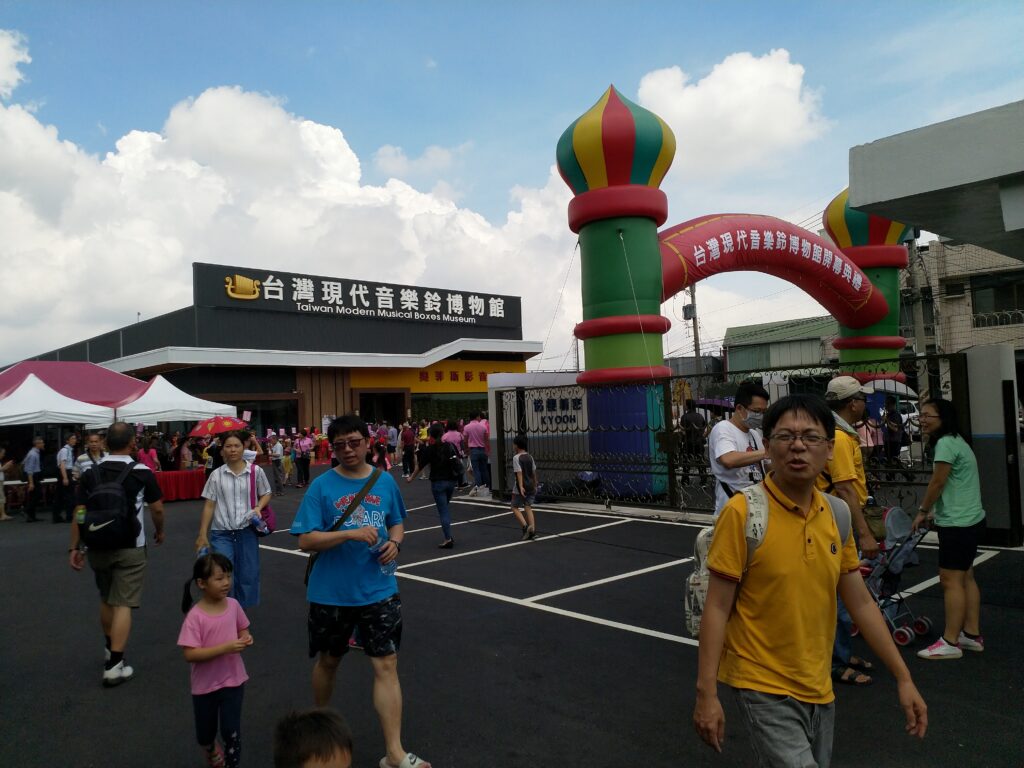
On June 29, 2019, the Music Box Museum opened—Wufeng celebrated as if it were a wedding.
This image captures the opening day of the Music Box Museum on June 29, 2019. The atmosphere in Wufeng was festive and heartfelt, as if the entire town had gathered for a joyous occasion. More than just a museum launch, it marked a moment of shared pride and cultural connection for the local community—an unforgettable day etched in memory.

Overall, the decline of the music box industry has been a relentless process. Beyond the U.S. copyright lawsuits and low-priced dumping from mainland China mentioned earlier, other recurring challenges Kyooh often faces include China’s anti-luxury policies, the impact of the pandemic, wars, and U.S. tariffs. Taiwan’s music box industry had already collapsed long ago. Today, it is not a matter of thinking about how to revive it, but rather quietly observing when the “stop” button will finally be pressed.

After these years of reflection, we have gradually come to understand that perhaps following the natural course of time is the way of the world. Music boxes began in Europe, then moved to the U.S., Southeast Asia, Japan, Taiwan, and finally to mainland China. Rather than dwell in nostalgia, what we need to do is document and preserve everything that still exists today.

As General Manager Huang Long-Xi said in a recent interview:

“Music box movements are made in Wufeng, Taiwan.” People need to know this because for over 40 years, there have been so many kinds of music box movements, and Kyooh is the only one factory in Taiwan. Therefore, Kyooh needs to establish a museum, to preserve this culture and this history, and to carry forward Taiwan’s unique heritage of music box movements.”

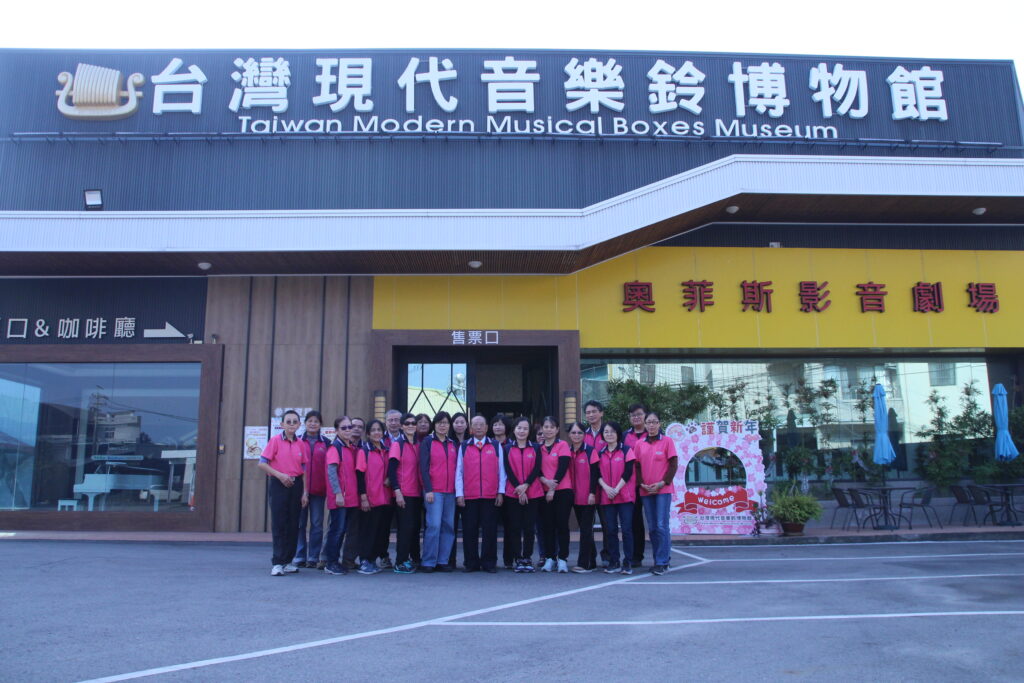
On February 27, 2025, Kyooh Precision Industry staff gathered for a group photo in front of the Taiwan Modern Music Box Museum.
This image captures the entire Kyooh Precision Industry team posing in front of the Taiwan Modern Music Box Museum on February 27, 2025. The photo commemorates a meaningful moment for the company, reflecting its dedication to music box heritage and the strong unity within the team.